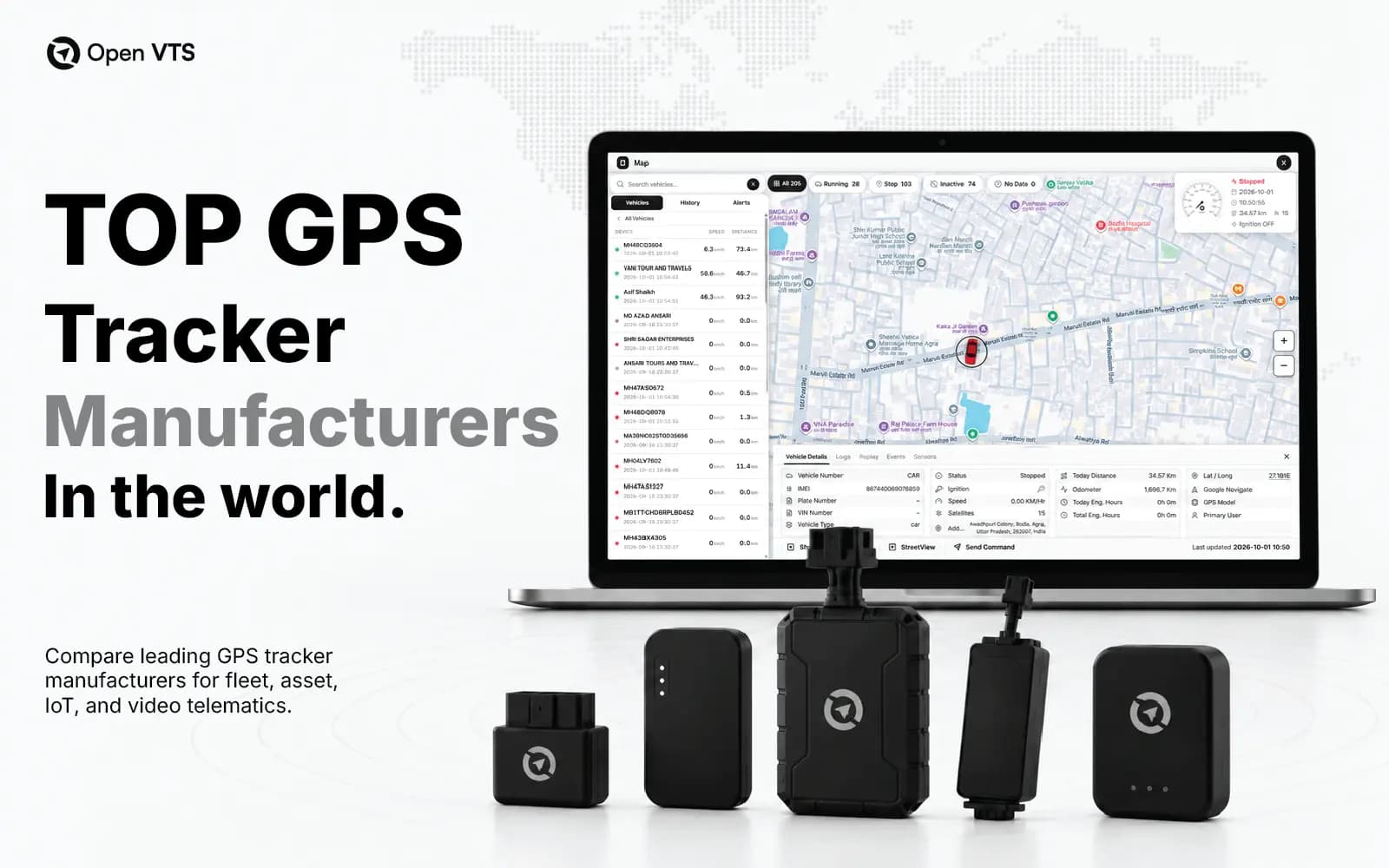
Top GPS Tracker Manufacturers in the World
Every location pin on a fleet dashboard begins somewhere far less visible: inside a tracking device installed in a vehicle, trailer, machine, or asset.
If that device reports late, loses data, misreads ignition, fails under harsh conditions, or depends on a network approaching retirement, even excellent tracking software is working with compromised information.
That is why choosing a GPS tracker manufacturer is not simply a hardware purchase. For fleet operators, GPS tracking businesses, system integrators, and logistics companies, it is an infrastructure decision.
The manufacturers below represent established and emerging names across vehicle tracking, asset tracking, professional telematics, IoT, and video telematics. This is not a market-share ranking. The objective is more useful: understand where each manufacturer is strongest and determine which hardware fits your tracking environment.
How We Selected These GPS Tracker Manufacturers
The selection focuses specifically on manufacturers relevant to commercial GPS tracking and telematics not consumer navigation brands or companies that only manufacture GNSS chips and modules.
We considered product breadth, commercial fleet relevance, modern cellular connectivity, vehicle and asset tracking capabilities, CAN/OBD and sensor integration, video telematics where applicable, protocol and integration support, international presence, and suitability for long-term deployments.
That distinction matters because the “best” tracker on paper can still be the wrong device for a particular fleet.
GPS Tracker Manufacturers at a Glance
| Manufacturer | Strongest Area | Hardware Focus |
|---|---|---|
| Teltonika Telematics | Professional fleet telematics | Vehicle, CAN/OBD, asset, sensors, video |
| ST SUNLAB / Suntech | Established commercial telematics | Wired, battery, OBD, video, OEM |
| Jimi IoT / Concox | High-volume tracking deployments | Vehicle, asset, OBD, solar, IoT |
| Ruptela | Advanced commercial fleets | CAN/OBD, heavy vehicles, assets |
| Queclink | Broad enterprise IoT | Vehicle, asset, micromobility, video |
| iStartek | OEM/ODM and customization | Vehicle, asset, dashcam, IoT |
| WanWayTech | Customizable tracking projects | Vehicle, asset, 4G, video telematics |
| Howen Technologies | Video-first fleet telematics | AI dashcams, MDVR, MDT, cameras |
| Streamax Technology | AI fleet safety and video | Commercial-vehicle video telematics |
| SEEWORLD | B2B location IoT | Vehicle, asset, OBD, dashcam |
The table is a starting point, not a purchasing verdict. Device model, protocol, network bands, firmware, regional certification, and software compatibility still need to be checked before procurement.
Top GPS Tracker Manufacturers
Teltonika Telematics
Positioning: A major name in professional vehicle telematics, with hardware spanning basic fleet tracking through advanced CAN, OBD, asset, sensor, and video applications.
Notable capabilities: Its portfolio covers different deployment levels, while configuration and remote device-management tools support larger installations. The company also addresses logistics, rentals, e-mobility, construction, driver safety, and other specialized fleet scenarios.
Best suited for: Fleet operators and telematics providers that need a broad hardware ecosystem with strong configuration and integration options.
ST SUNLAB / Suntech
Positioning: The company began as Suntech International in Seoul in 2001 and evolved into ST SUNLAB after its 2023 merger with WizardLab, extending its scope from aftermarket tracking into automotive and integrated OEM applications.
Notable capabilities: Its current portfolio includes wired, battery-operated and OBD tracking devices alongside video telematics, maintenance tools, connectivity modules, and custom automotive solutions.
Best suited for: Businesses looking for an established telematics manufacturer serving both conventional tracking and deeper automotive integration.
Jimi IoT / Concox
Positioning: Jimi IoT combines the widely recognized Concox hardware heritage with a large portfolio covering vehicle, asset, OBD, personal, and specialized IoT tracking. Jimi reported fully acquiring Concox in 2020.
Notable capabilities: Available device families include 4G LTE/Cat-1 hardware, LTE-M/NB-IoT models, solar-powered asset trackers, OBD devices, multiple sensor interfaces, and long-life battery designs.
Best suited for: High-volume GPS tracking businesses requiring diverse form factors across different commercial applications.
Ruptela
Positioning: A Lithuania-headquartered telematics manufacturer focused strongly on commercial fleet hardware, from straightforward plug-and-play tracking to advanced vehicle-data integration.
Notable capabilities: Its Basic, Smart, and Advanced ranges include asset tracking, CAN and OBDII reading, diagnostics, trailer and reefer data, and remote tachograph applications. The company develops its hardware in-house and reports serving customers across more than 150 countries.
Best suited for: Logistics, transport, and heavy commercial fleets that need deeper vehicle data beyond basic location tracking.
Queclink
Positioning: An enterprise IoT hardware manufacturer with a particularly broad footprint across conventional tracking and newer connected-asset applications.
Notable capabilities: Its portfolio spans hardwired vehicle trackers, long-life asset devices, micromobility hardware, accessories, and video telematics. Some asset families combine multi-year standby designs with IP-rated housings, BLE, Wi-Fi positioning, or solar charging.
Best suited for: Businesses managing mixed fleets or multiple asset categories that want to source different tracking formats from one hardware ecosystem.
iStartek
Positioning: A Shenzhen-based IoT manufacturer with an emphasis on GPS hardware development, manufacturing, customization, and OEM/ODM requirements.
Notable capabilities: Its portfolio covers vehicle, personal and asset trackers, dashcams, routers, and GPS accessories, with technologies including 2G/3G/4G, NB-IoT and LoRa across its wider positioning range.
Best suited for: Tracking providers that value hardware customization and want a manufacturer capable of supporting specialized deployment requirements.
WanWayTech
Positioning: A Shanghai-based GPS and IoT manufacturer serving fleet management, car rental, logistics, asset management, insurance, and related tracking applications.
Notable capabilities: Its catalog includes 4G vehicle trackers, portable asset trackers, ADAS/DMS video devices, sensors, OEM/ODM services, OTA firmware updates, and protocol-integration support.
Best suited for: Commercial tracking providers looking for configurable hardware, OEM/ODM options, and a combination of conventional GPS and video telematics.
Howen Technologies
Positioning: Howen sits closer to the video-telematics end of the market than to basic GPS tracking. Its focus is commercial-vehicle monitoring and fleet safety.
Notable capabilities: The portfolio includes AI-enabled dashcams, MDVR/MNVR systems, mobile data terminals, vehicle cameras, DMS and ADAS capabilities, plus integration with third-party fleet-management platforms.
Best suited for: Fleets where driver monitoring, video evidence, safety events, and visual fleet intelligence matter as much as location.
Streamax Technology
Positioning: Another specialist at the intersection of telematics, AI, and commercial-vehicle video, with applications across trucking, public transit, school buses, taxis, mining, and OEM projects.
Notable capabilities: Its approach centers on vision-based AI and fleet-safety solutions rather than simple location-only tracking, supported by operations across multiple international markets.
Best suited for: Large commercial fleets and transport operations building safety-focused, video-intensive telematics systems.
SEEWORLD
Positioning: A B2B location-IoT provider offering tracking hardware alongside broader fleet and connected-asset solutions.
Notable capabilities: Its catalog includes wired and wireless vehicle trackers, OBD devices, 4G hardware, asset trackers, and dashcams for applications ranging from logistics and rental fleets to construction and equipment monitoring.
Best suited for: GPS tracking businesses seeking a broad commercial hardware range covering vehicles, assets, and common fleet deployments.
Before Choosing Right GPS Tracker Manufacturer
Brand recognition is useful. Deployment fit is more important.
Before committing to hundreds or thousands of devices, evaluate the manufacturer at the level where failures actually happen:
- Start with the use case: wired vehicle tracking, OBD, motorcycles, trailers, non-powered assets, CAN data, cold chain, or video telematics all demand different hardware.
- Plan for the network lifecycle: verify LTE/Cat-1, LTE-M, NB-IoT, fallback technologies, frequency bands, SIM requirements, and the network roadmap in every country of deployment.
- Check the data you actually need: ignition, digital inputs, fuel, temperature, driver ID, CAN/OBD, BLE sensors, cameras, and remote commands should be confirmed model by model.
- Inspect the protocol and documentation: hardware is far easier to integrate when protocol specifications, parameter definitions, firmware documentation, and configuration tools are mature.
- Evaluate device management: firmware updates, OTA/FOTA capabilities, remote configuration, offline data storage, and troubleshooting become critical once devices are distributed across a large fleet.
- Verify physical and regulatory fit: operating temperature, ingress protection, voltage range, certifications, installation requirements, and battery design should match the deployment environment.
- Look beyond the purchase price: distributor support, warranty, replacement stock, firmware continuity, installer familiarity, and long-term supply can matter more than saving a few dollars per unit.
The strongest procurement process therefore does not begin with, Which brand is most popular?
It begins with, What data must this operation collect reliably for the next several years?
GPS Hardware and Open VTS: Compatibility Comes Before Procurement
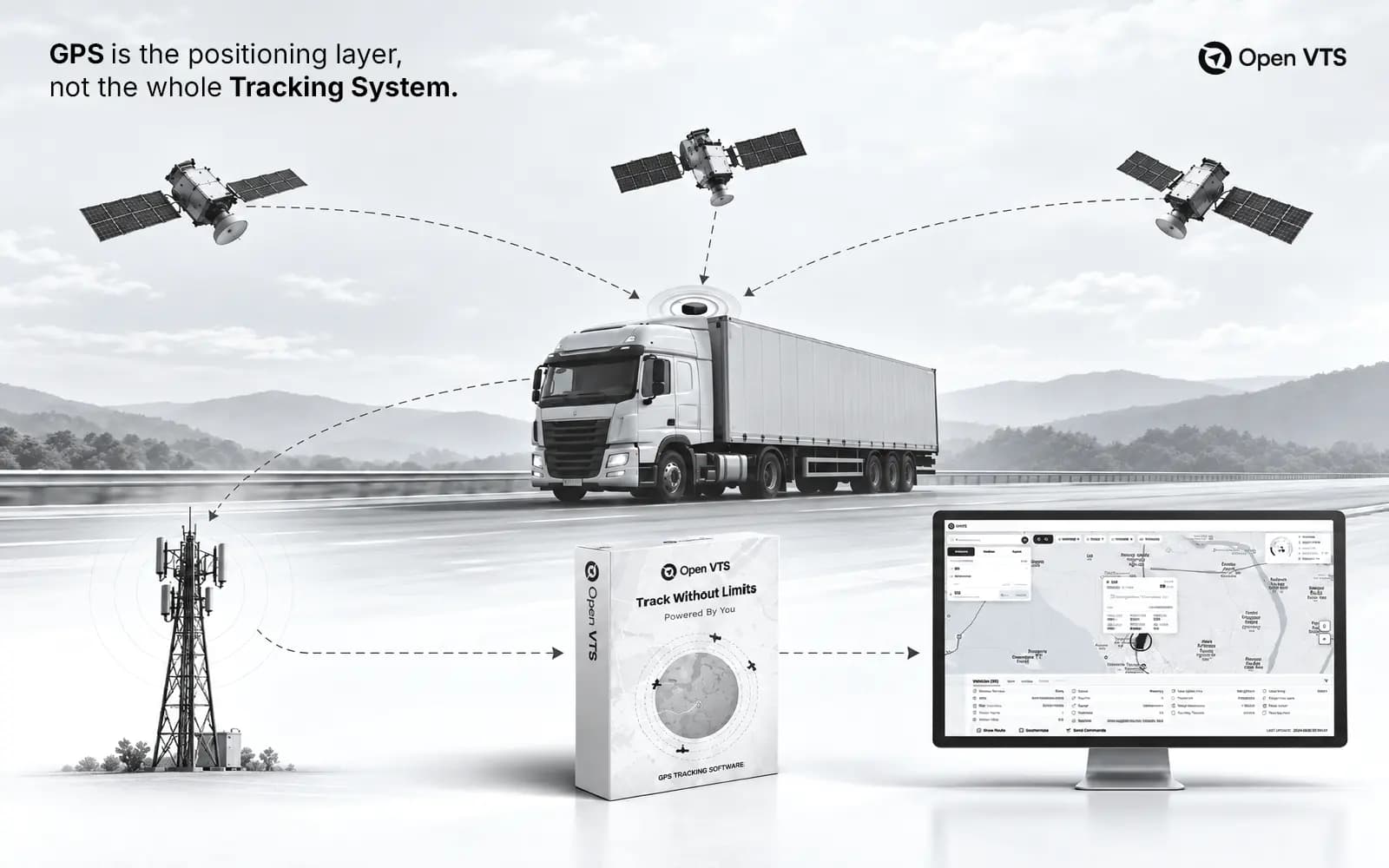
A GPS tracker and GPS tracking software perform different jobs.
The tracker collects and transmits information. The software receives that information, interprets the device protocol, and turns raw data into live locations, route history, geofences, alerts, reports, and operational visibility.
Open VTS belongs to the software side of that equation. It is a self-hosted GPS tracking platform rather than a GPS tracker manufacturer.
For businesses considering devices for Open VTS or any self-hosted tracking environment the manufacturer name alone is therefore not enough. The exact device model and protocol should be checked before a large hardware order. Required parameters such as ignition, speed, sensors, CAN data, alerts, and commands must also be mapped correctly.
A powerful tracker speaking a protocol your platform cannot properly interpret is not powerful infrastructure. It is simply incompatible hardware.
Final Perspective
The right GPS tracker manufacturer is not necessarily the company with the longest product catalog, the lowest device price, or the most recognizable name.
It is the manufacturer whose hardware fits your vehicles, captures the data your operation actually needs, survives your network and environmental conditions, integrates cleanly with your software, and can still be supported years after deployment.
That is the standard worth buying against.
Because reliable fleet intelligence is not created on the dashboard.
It begins with the quality of the data reaching it.