
Waste management looks simple from the outside.
A garbage truck comes, collects waste, and moves to the next location.
But anyone who manages a waste collection fleet knows the reality is very different.
There are routes to follow, pickups to complete, drivers to manage, fuel costs to control, customer complaints to answer, vehicles to maintain, and reports to submit. One missed street, one delayed truck, or one vehicle breakdown can affect the entire day’s operation.
This is why GPS tracking software has become so important for waste management fleets.
It helps businesses and municipalities see where their vehicles are, where they have been, how long they stopped, whether they followed the assigned route, and whether collection work was completed properly.
For waste management companies, GPS tracking is not just about watching vehicles on a map. It is about building a cleaner, more accountable, and more controlled operation.
Open VTS helps businesses do this with self-hosted GPS tracking software. That means waste management companies can track vehicles, monitor routes, use geofencing, review reports, and manage fleet data on their own infrastructure instead of depending completely on a locked SaaS platform.
What Is Waste Management GPS Tracking Software?
Waste management GPS tracking software is a vehicle tracking system designed to monitor garbage trucks, recycling vehicles, dump trucks, skip loaders, roll-off trucks, collection vans, street cleaning vehicles, and other waste fleet assets.
It gives fleet managers real-time visibility into vehicle movement.
With GPS tracking software, managers can see:
- Where each vehicle is right now
- Which route a vehicle followed
- Where the vehicle stopped
- How long it stayed at each location
- Whether the vehicle reached the collection zone
- Whether the vehicle visited the dump yard
- Whether the driver followed the assigned route
- Whether there were delays, long stops, or unusual movement
In simple words, waste management GPS tracking software gives the operations team a live control room for their fleet.
Instead of depending only on phone calls and manual reports, managers can use real data from the vehicles.
Why Waste Management Fleets Need GPS Tracking
Waste collection fleets are different from normal transport fleets.
A regular delivery truck may go from one warehouse to one customer location.
But a waste collection vehicle may visit dozens or even hundreds of collection points in one shift. It may move through narrow streets, residential areas, commercial zones, industrial areas, transfer stations, and dump yards.
This creates many operational problems.
A supervisor may not know whether every street was covered. A customer may complain that the truck never arrived. A driver may take a different route. A vehicle may waste fuel due to unnecessary idling. A truck may reach the dump yard late. A contractor may need proof of work for a municipal client.
Without GPS tracking, many of these problems are difficult to verify.
How GPS Tracking Works in Waste Management Fleets
GPS tracking works through a simple process.
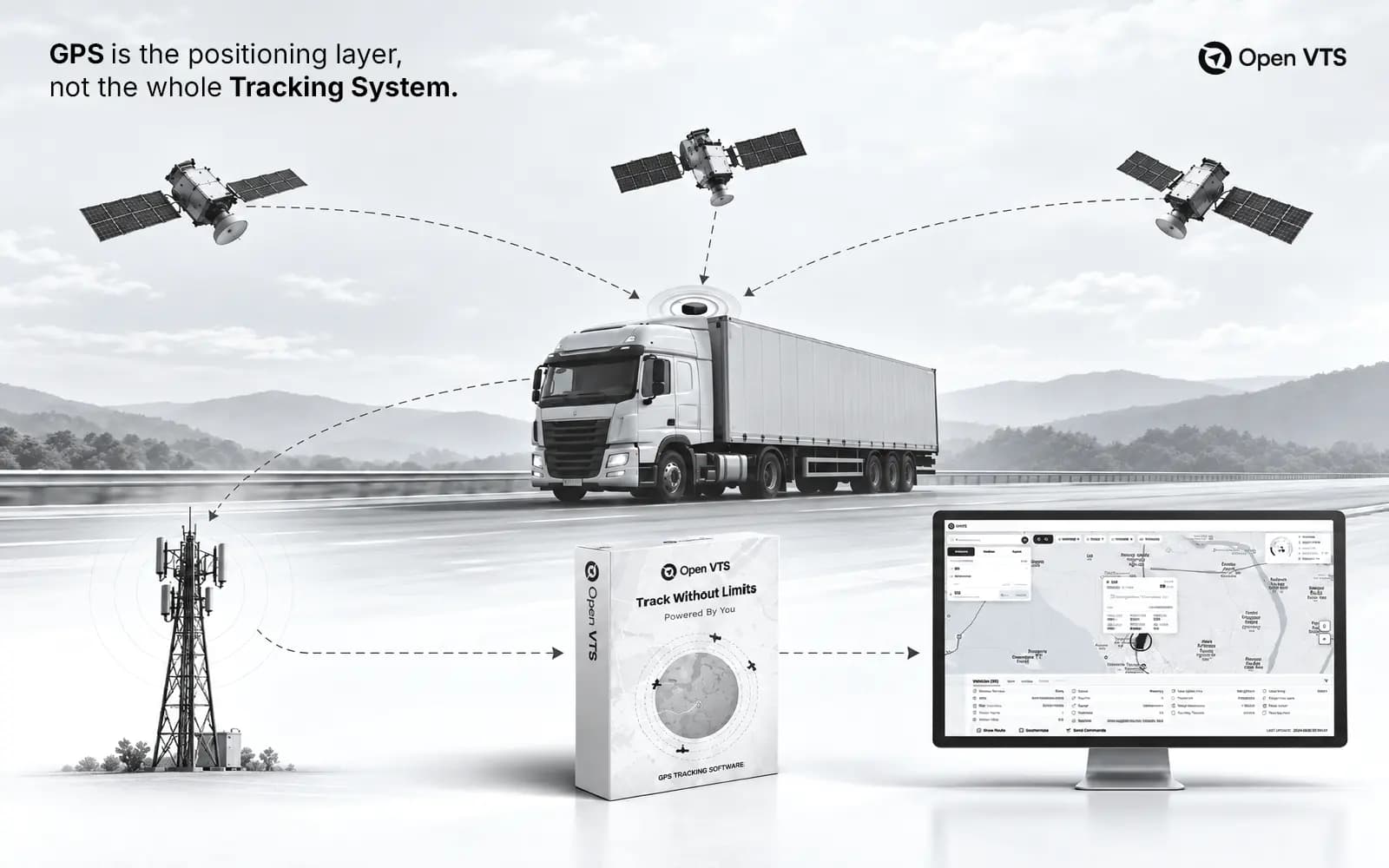
First, a GPS device is installed in the waste collection vehicle. This device collects location data from satellites. Then it sends that data to the tracking server using GSM or mobile network connectivity.
The GPS tracking software receives this data and shows vehicle movement on a map.
The system can record:
- Vehicle location
- Speed
- Route history
- Stops
- Idle time
- Ignition status
- Entry and exit from geofences
- Driver behavior, if supported
- Fuel data, if sensors are integrated
Managers can then use this information to monitor the fleet in real time and review historical movement later.
For example, if someone complains that a garbage truck did not visit a location, the manager can check the route history and confirm whether the vehicle actually passed that area.
This is how GPS tracking turns daily waste operations into trackable, reportable, and manageable activity.
1. Real-Time Visibility of Garbage Trucks
The first and most important benefit of GPS tracking software is real-time visibility.
Waste fleet managers can see all active vehicles on a map.
This helps answer practical questions like:
- Where is the nearest truck?
- Which vehicle is delayed?
- Which truck has completed its route?
- Which driver is still on duty?
- Which vehicle is standing idle?
- Which area has not been covered yet?
- Which truck is moving toward the dump yard?
- Which vehicle has returned to the depot?
In waste management, visibility is not a luxury. It is necessary.
If a route is delayed, complaints can start quickly. If a vehicle breaks down, another truck may need to be assigned. If a customer or municipality asks for an update, the operations team needs a clear answer.
With GPS tracking, supervisors do not need to keep calling every driver again and again.
They can see the fleet status directly.
With Open VTS, this visibility can be managed on a self-hosted platform. Waste management companies can monitor their fleet from their own GPS tracking system and keep operational data under their own control.
2. Better Route Monitoring
Routes are the backbone of waste collection.
If a vehicle misses one street, one ward, one society, or one commercial location, the service quality is affected.
GPS tracking software helps managers compare actual vehicle movement with expected routes.
This helps identify:
- Missed roads
- Skipped collection points
- Route deviation
- Unnecessary detours
- Repeated delays
- Overlapping routes
- Inefficient travel
- Poor route discipline
For example, if a garbage truck was assigned to cover a specific ward, the manager can review the route history and check whether the vehicle actually covered that area.
This is especially important for municipal waste contracts, where route completion and proof of service matter.
Open VTS helps businesses review route movement and vehicle history so teams can understand what happened during the day, not just where the vehicle is right now.
3. Reducing Missed Pickups
Missed pickups are one of the biggest problems in waste management.
A resident, housing society, shop, factory, or municipal officer may complain:
“The truck did not come today.”
Without GPS tracking, the company may have no clear proof.
The driver may say the vehicle visited the location. The customer may say it did not. The supervisor may not know what actually happened.
GPS tracking helps solve this problem.
The manager can check:
- Did the vehicle visit that area?
- What time did it reach?
- Did it stop there?
- How long did it stay?
- Did it pass nearby but not enter the lane?
- Was the route skipped completely?
This helps reduce disputes and improves accountability.
It also helps the company identify repeated problem areas. If the same location is missed again and again, the route may need to be changed, the driver may need support, or the schedule may need improvement.
For waste management fleets, reducing missed pickups directly improves customer satisfaction and contract performance.
4. Geofencing for Depots, Dump Yards, Wards, and Collection Zones
Geofencing is one of the most useful features for waste management fleets.
A geofence is a virtual boundary created around a real location.
For waste operations, geofences can be created around:
- Depots
- Parking yards
- Dump yards
- Transfer stations
- Recycling centers
- Ward boundaries
- Collection zones
- Housing societies
- Industrial customer sites
- Restricted areas
When a vehicle enters or exits these locations, the system can record the event.
This is very useful.
For example, a company can know:
- When the truck left the depot
- When it entered the assigned collection zone
- When it reached the dump yard
- How long it stayed at the transfer station
- Whether it returned to base
- Whether it entered an unauthorized area
- Whether it left the yard after working hours
Open VTS helps businesses use geofencing as part of their self-hosted GPS tracking system. This means geofence data, entry-exit history, and fleet reports can remain under the company’s control.
For municipalities and private contractors, this is important because waste movement data can be sensitive and operationally valuable.
5. Fuel Cost Control
Fuel is one of the biggest costs in waste management operations.
Garbage trucks and waste vehicles often run for long hours, move through slow traffic, stop frequently, and idle at collection points or dump yards.
Small fuel wastage across many vehicles can become a large expense.
GPS tracking software helps reduce fuel waste by identifying:
- Long idling
- Extra kilometers
- Route deviation
- Unauthorized trips
- Poor route planning
- Harsh driving
- Unnecessary stops
- After-hours vehicle use
When fuel sensors are integrated, the system may also help monitor:
- Fuel filling
- Fuel consumption
- Sudden fuel drop
- Possible fuel theft
- Vehicle-wise fuel usage
Even without advanced fuel sensors, GPS tracking can still help reduce fuel waste by improving routes, reducing idle time, and controlling unauthorized movement.
For waste fleets with many vehicles, this can create meaningful savings over time.
6. Idle Time Monitoring
Idle time is common in waste management.
Vehicles may wait at collection points, transfer stations, weighing bridges, traffic signals, or dump yards.
Some waiting time is normal.
But excessive idling wastes fuel, increases engine wear, and reduces productivity.
GPS tracking software can show:
- Which vehicles idle the most
- Where idling happens
- How long each vehicle stays idle
- Which drivers need coaching
- Which locations cause repeated delays
- Which routes need improvement
For example, if a truck spends too much time waiting at a dump yard every day, the issue may not be with the driver. The company may need better scheduling or coordination at the disposal site.
Good GPS tracking does not only show problems. It helps managers understand why those problems are happening.
7. Driver Accountability and Safer Driving
Waste collection vehicles often operate in difficult environments.
They move through narrow streets, residential colonies, crowded markets, school areas, industrial zones, and city roads.
Driver behavior matters.
GPS tracking and telematics can help monitor:
- Speeding
- Harsh braking
- Harsh acceleration
- Long idle time
- Unauthorized stops
- Off-route movement
- Risky driving patterns
This helps managers improve driver accountability.
But GPS tracking should not be used only to punish drivers.
A good fleet manager uses tracking data to improve safety, reduce pressure, and support better driving habits.
If a driver is taking a risky route, the route can be improved.
If a driver is under time pressure, the schedule can be reviewed.
If harsh braking is happening in the same area every day, there may be road, traffic, or route issues.
When used properly, GPS tracking helps protect drivers, vehicles, and the public.
8. Faster Customer Complaint Resolution
Customer complaints are common in waste collection.
People may say:
- The truck did not come.
- The driver skipped our lane.
- Pickup was late.
- Waste was not collected.
- The vehicle came but did not stop.
- The truck came at the wrong time.
Without GPS records, it is hard to respond confidently.
With GPS tracking, the team can check historical data.
They can review:
- Vehicle route
- Time of visit
- Stop duration
- Location history
- Route playback
- Geofence records
- Collection zone coverage
This helps the company respond with facts instead of assumptions.
If the truck visited the location, the company can show proof. If the truck missed the location, the company can accept the issue and fix the route.
Both outcomes are better than confusion.
9. Proof of Service for Municipal and Private Contracts
Waste management companies often work with municipalities, housing societies, industrial clients, commercial buildings, and government departments.
In these contracts, proof of service matters.
The client may want to know:
- Did the vehicle visit the assigned ward?
- Was the route completed?
- Did the truck reach the dump yard?
- How many trips were completed?
- Was the collection zone covered?
- Did the vehicle operate during the assigned shift?
GPS tracking reports can support this.
They can help show vehicle movement, route history, stop records, and geofence entry-exit events.
For contractors, this can reduce payment disputes and improve client trust.
For municipalities, it can improve public service transparency.
Open VTS is useful in this environment because it gives businesses and public-sector operators more control over their tracking infrastructure and fleet data.
10. Dump Yard and Transfer Station Monitoring
Waste collection does not end when the truck collects waste.
The vehicle must usually go to a dump yard, transfer station, recycling center, or processing plant.
GPS tracking can monitor this full cycle.
Managers can track:
- Arrival at dump yard
- Exit from dump yard
- Time spent unloading
- Number of dump yard trips per day
- Turnaround time
- Delays at disposal sites
- Unauthorized dumping risk
- Return-to-depot movement
This is important because waste management performance depends on the complete movement cycle, not just collection.
If trucks spend too much time at transfer stations, route schedules may fail.
If vehicles take unauthorized disposal routes, the company may face compliance issues.
GPS tracking helps bring clarity to these movements.
11. Vehicle Utilization and Productivity
In many fleets, some vehicles are overused while others are underused.
This creates imbalance.
One truck may run longer routes every day, while another vehicle stays idle or completes shorter trips.
GPS tracking helps managers compare vehicle usage.
They can check:
- Distance traveled
- Time spent moving
- Time spent stopped
- Number of trips completed
- Route completion
- Collection area coverage
- Dump yard visits
- Daily working hours
- Vehicle productivity
This helps balance work across the fleet.
Better utilization means the company can do more with the same number of vehicles.
It may also help delay unnecessary vehicle purchases because the existing fleet is being used more effectively.
12. Preventive Maintenance and Vehicle Health
Waste vehicles work in tough conditions.
They stop frequently, carry heavy loads, move through difficult roads, and operate for long hours.
Breakdowns can disrupt the entire collection schedule.
GPS tracking and telematics data can support maintenance planning by tracking:
- Mileage
- Engine hours
- Usage patterns
- Idle hours
- Harsh driving
- Service intervals
- Vehicle activity history
This helps managers plan maintenance before a breakdown happens.
For example, if one truck is running more kilometers than others, it may need service sooner.
If a vehicle idles too much, engine wear may increase.
If a vehicle is used heavily on rough routes, it may need more frequent inspection.
Preventive maintenance helps improve vehicle availability and reduce emergency repair costs.
13. Reducing Unauthorized Vehicle Use
Waste vehicles are meant to follow assigned routes and schedules.
But without tracking, unauthorized use can happen.
A vehicle may be used after working hours. A driver may take a personal detour. A truck may leave the assigned route. A vehicle may stop at unauthorized locations.
GPS tracking helps detect this.
Managers can monitor:
- After-hours movement
- Off-route driving
- Long personal stops
- Entry into restricted areas
- Movement outside assigned zones
- Unauthorized depot exit
This improves security and reduces operational leakage.
Conclusion
GPS tracking software improves waste management fleets by giving managers clear visibility into vehicles, routes, drivers, stops, fuel usage, and service performance.