What Is a REST API in GPS Tracking Software? Complete Guide (2026)
A GPS tracking platform can know where 500 vehicles are, which drivers are active, which vehicles crossed a geofence, and which trips were completed. But if that information cannot reach your dispatch system, customer portal, mobile app, ERP, or billing software, much of its business value remains trapped inside one platform. That is where APIs become important.
A REST API gives other applications a structured way to request or change information in GPS tracking software. It can turn a tracking platform from an isolated map into part of a connected business infrastructure. But there is an important distinction: REST does not automatically mean real-time, secure, or even GPS-specific. Understanding where it fits and where technologies such as webhooks and Web Sockets fit instead is what makes an API genuinely useful.
What Is a REST API?
REST stands for Representational State Transfer. More precisely, REST is an architectural style for designing networked applications and APIs not a GPS protocol itself. A REST API exposes resources, such as vehicles, drivers, trips, or geofences, through defined endpoints. A client application sends an HTTP request to an endpoint, and the server returns a response.
Common HTTP methods include:
- GET : retrieve a resource or its representation.
- POST : submit data, commonly to create something or trigger an operation.
- PUT : create or replace the representation of a resource.
- PATCH : apply partial modifications.
- DELETE : request deletion of a resource.
These methods have defined HTTP semantics; for example, PUT is idempotent while POST is not guaranteed to be. JSON is a very common response format for modern REST APIs, but REST itself does not require JSON. A REST API is a structured interface that lets software work with resources over HTTP. In GPS tracking, those resources might include vehicles, positions, trips, drivers, geofences, alerts, and reports.
Where Does a REST API Fit in GPS Tracking?
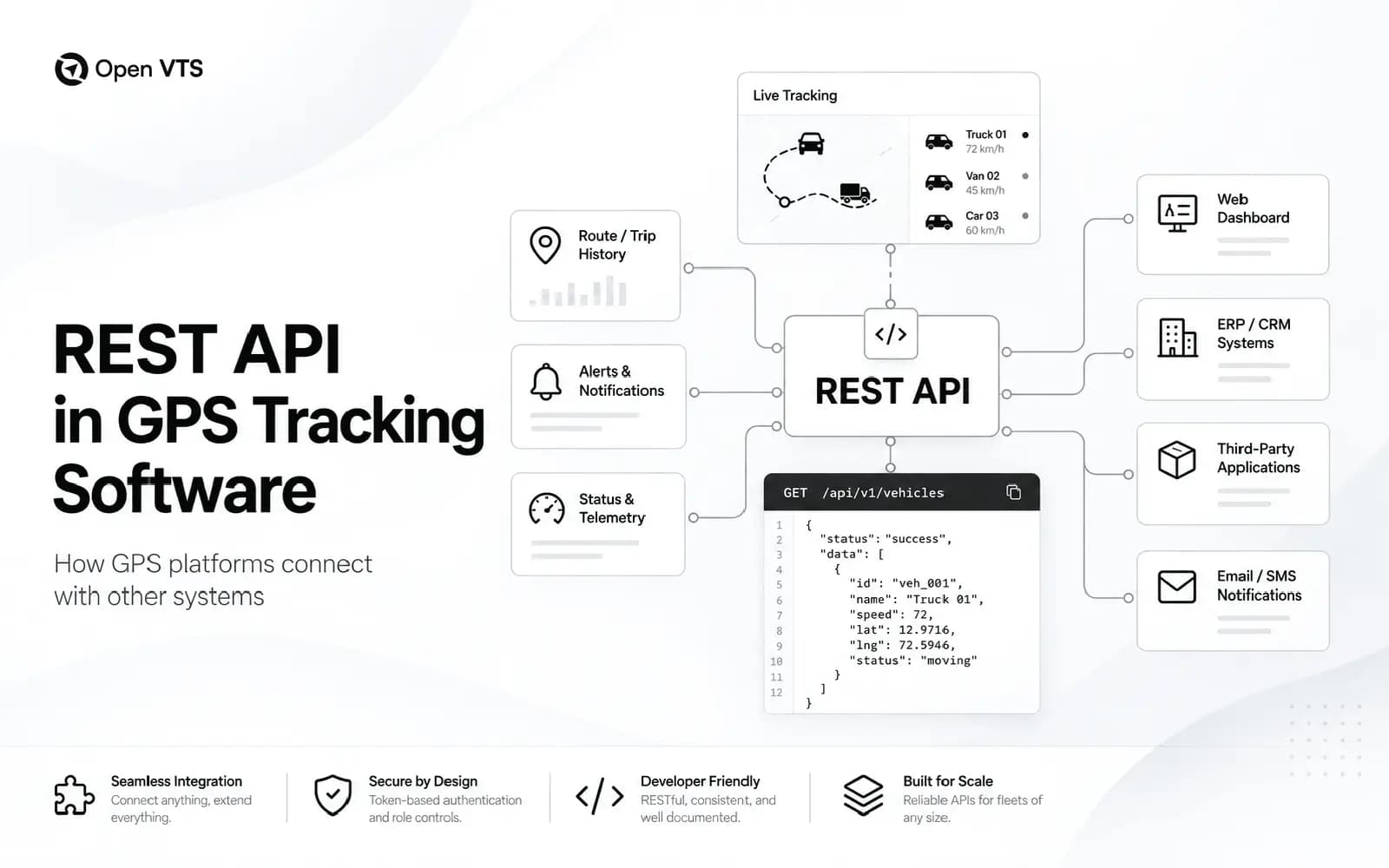
This is where GPS APIs are often misunderstood. A tracker installed in a vehicle does not necessarily send its telemetry to the tracking server through a REST API. GPS and telematics devices frequently communicate using manufacturer- or device-specific protocols. The tracking platform receives and interprets that telemetry first. The REST API usually sits on another side of the system, exposing processed information to applications that need it.
Imagine a logistics company wants its customer portal to display the latest recorded location of a delivery vehicle. The GPS tracker sends location information to the tracking platform. The platform processes and stores it. The customer portal then sends a request such as: GET /vehicles/102/location. The portal can use that response to update its interface without employees copying locations between systems. That is the real role of the API: make GPS platform data usable somewhere else.
REST API Does Not Always Mean “Real-Time”
One of the most important distinctions for buyers and developers is the difference between requesting current data and receiving events as they happen. REST normally follows a request-response model. An application asks for information; the server responds.
If an application calls a location endpoint every 30 seconds, it can provide a near-live experience. But its freshness depends on the GPS device reporting interval, network latency, server processing, caching, and how frequently the client requests new information. For events that need to be pushed automatically, other mechanisms may be better.
| Method | How It Works | Useful For |
|---|---|---|
| REST API | Client requests data | Vehicles, trips, reports, configuration |
| Webhook | Server sends an HTTP notification when an event occurs | Geofence entry, completed delivery, alerts |
| WebSocket / streaming | Persistent connection carries ongoing updates | Continuously updating maps and live dashboards |
A good integration may use all three. For example, a webhook could tell an ERP that a delivery was completed, REST could retrieve the complete trip record, and a WebSocket connection could continuously update vehicle positions on an operations dashboard.
What Can a GPS Tracking REST API Do?
The exact endpoints vary by platform, but useful GPS and fleet APIs commonly expose several resource groups.
- Vehicle and asset data can include vehicle records, latest positions, status, device assignments, or historical locations.
- Trips and routes may expose completed journeys, mileage, stops, durations, route information, or utilization data.
- Drivers and users can support profiles, assignments, permissions, and operational workflows.
- Geofences and events can make boundary events, ignition changes, speeding events, or other alerts available to connected systems.
- Reports and administration may expose analytics, configuration, account information, devices, or operational records.
The important question is not how many endpoints an API advertises. It is whether it exposes the specific resources, fields, actions, and event mechanisms your integration needs.
Where GPS APIs Create Business Value
- Customer Tracking: A customer portal can request the latest available vehicle or shipment-related information without requiring support staff to repeatedly open the fleet platform.
- ERP, Dispatch and Billing Workflows: Trip completion, distance, vehicle activity, or delivery events can feed operational systems. Depending on the integration, this can trigger subsequent workflows such as updating job status or preparing billing data.
- Mobile Applications: Driver and fleet-management apps can retrieve vehicle assignments, trips, alerts, account information, or other authorized resources from the same backend used by the wider tracking system.
- Analytics and Business Intelligence: Fleet data can be moved into reporting environments through APIs, middleware, connectors, or ETL pipelines. This allows operational information to be analysed alongside other business data without assuming every BI product connects directly to every GPS API. The pattern is consistent: Collect once. Make the right data available wherever the business actually needs it.
What Makes a Good GPS Tracking API?
An endpoint list alone tells you surprisingly little about integration quality. Before choosing GPS tracking software for serious integrations, evaluate the API as carefully as the dashboard.
- Clear Documentation: Developers should be able to understand authentication, resources, parameters, response schemas, errors, and examples without reverse-engineering the platform. Machine-readable specifications such as Open API can make development and testing considerably easier.
- Predictable Requests and Responses: Consistent resource naming, response structures, HTTP status codes, timestamps, units, and error formats reduce integration complexity.
- Filtering and Pagination: A fleet with thousands of vehicles or millions of historical records should not require one enormous response. Useful APIs provide mechanisms for querying, filtering, and paginating larger datasets.
- Rate and Resource Limits: Limits protect infrastructure from excessive or abusive requests. Buyers should understand the platform's limits before designing polling-heavy integrations.
- Error Handling and Safe Retries: Networks fail. Requests time out. Servers become temporarily unavailable. Integrations should handle these situations deliberately. HTTP semantics matter here: methods such as GET and PUT are defined as idempotent, while POST and PATCH are not inherently so. Blindly retrying a non-idempotent operation can create unintended duplicate actions.
- Backward Compatibility: APIs evolve. A mature platform needs a clear strategy for introducing changes without unexpectedly breaking existing customer integrations. URL versions such as /v1 are one approach not a universal requirement.
- Event and Streaming Support: REST is only part of the integration picture. For sophisticated tracking environments, webhook, WebSocket, Server-Sent Events, or other event mechanisms can complement REST and reduce unnecessary polling.
REST API Security: What Actually Matters?
Calling an API “RESTful” says nothing about whether it is secure. Transport should normally be protected using HTTPS/TLS, but encryption in transit is only one layer. A production GPS API should also address authentication, authorization, permissions, token or key protection, input validation, resource limits, logging, monitoring, and credential lifecycle management. This matters particularly in tracking systems because location information, driver records, operational history, and administrative functions can be sensitive.
OWASP's API Security guidance highlights risks such as broken object-level authorization, broken authentication, unrestricted resource consumption, broken function-level authorization, security misconfiguration, and poor API inventory management. A user who is authenticated should not automatically be allowed to access every vehicle. A valid token should not automatically mean unlimited requests. And an API endpoint should not expose more fields than the caller needs. Authentication proves who is calling. Authorization determines what that caller is allowed to do.
What Should Businesses Check Before Choosing a GPS API?
Before committing to a GPS tracking platform ask more useful questions:
- 1Does the API expose the exact vehicle, trip, driver, geofence, alert, and reporting data we require?
- 2How are authentication and role permissions handled?
- 3Are filtering, pagination, timestamps, error responses, and rate limits clearly documented?
- 4Does it support webhooks or streaming when polling is inefficient?
- 5How are breaking changes and backward compatibility managed?
- 6Can our developers test the API easily using clear documentation and examples?
- 7Can the integration scale to our expected vehicles, users, and request volume?
This evaluation matters far more than an impressive endpoint count.
How Open VTS Uses APIs
Open VTS provides a documented REST API for its self-hosted vehicle-tracking platform. Its current public API reference lists 426 endpoints across authentication, superadmin, admin, user, and health groups. The documentation identifies JSON responses, JWT Bearer authentication, role-based access, Server-Sent Events, and Socket.IO for real-time communication. Its authentication documentation also describes access and refresh tokens and distinguishes between authentication failures and insufficient permissions.
For businesses building customer portals, mobile applications, operational integrations, or other connected workflows, that means Open VTS can function as more than a standalone tracking interface. Because the platform is self-hosted, however, infrastructure control also brings infrastructure responsibility. API exposure, network security, monitoring, backups, updates, and deployment architecture still need to be managed correctly.
The Real Value of a GPS Tracking API
A GPS platform can collect extraordinary amounts of information. But information trapped inside one application has limited reach. A well-designed REST API gives that information somewhere to go to the dispatch system making the next decision, the customer portal answering the next question, the mobile application guiding the next task, or the business system triggering the next workflow. That is why the quality of a GPS API should never be judged simply by the number of endpoints it offers. The real measure is how reliably it delivers the right data, to the right system, at the moment that data can become action.