What Is Video Telematics? How Does Video Telematics Work?
A truck brakes hard at 2:14 PM. The fleet system records the location, speed, time, and sudden deceleration. The driver says a car cut across the lane. Someone else claims the truck was following too closely. The telematics data tells you "where and when" something happened. But it cannot show you "why?". That missing context is exactly what video telematics is designed to provide.
By synchronizing camera footage with GPS, vehicle, sensor, and driving-event data, video telematics gives fleet managers something numbers alone cannot: a visual record of the moments surrounding an event. It transforms a harsh-braking alert from a data point into a story. A collision becomes easier to reconstruct. A coaching conversation can start with evidence instead of assumptions. And that is why video is becoming an increasingly important layer of modern fleet technology.
What Is Video Telematics?
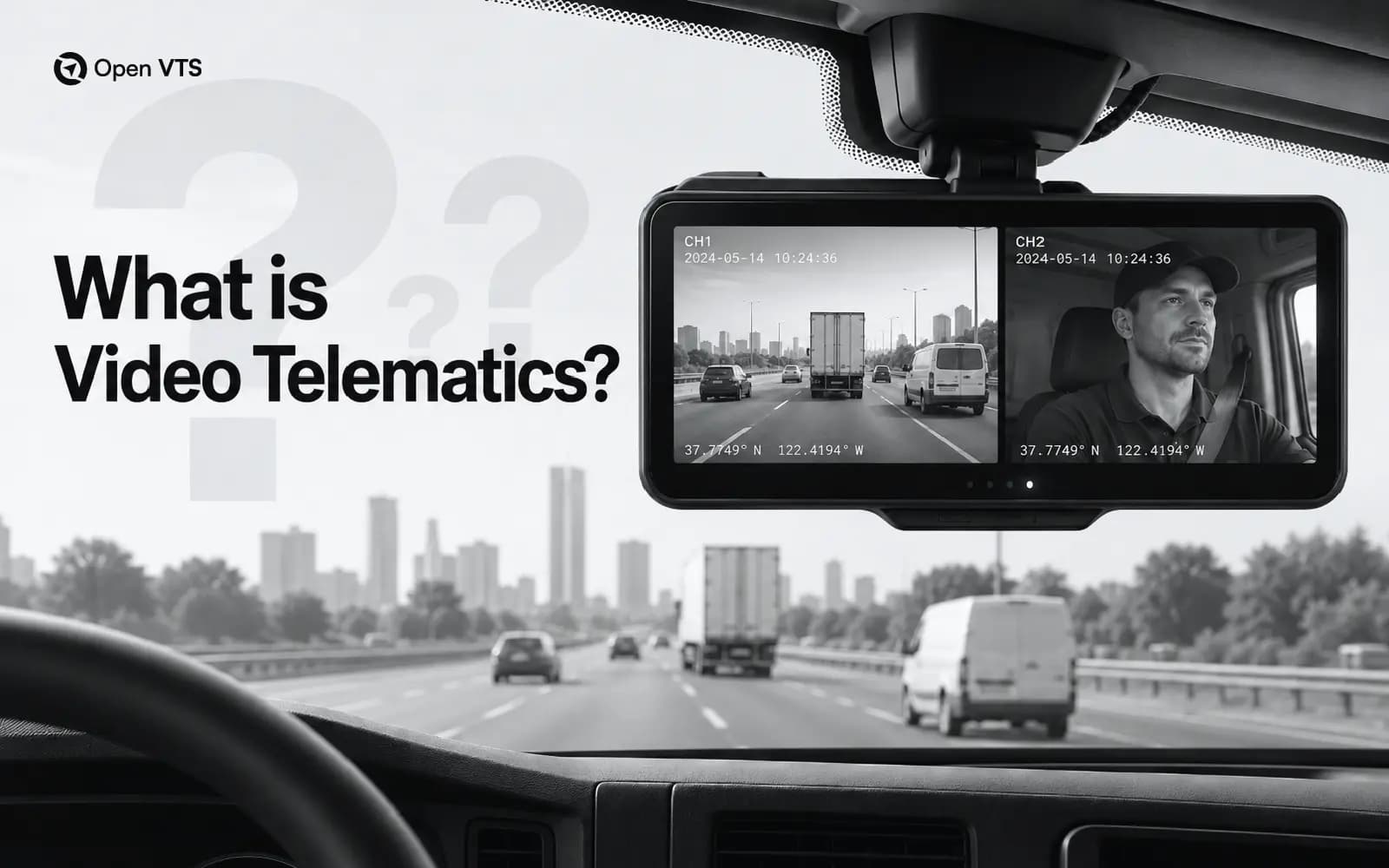
Video telematics is the combination of vehicle cameras and telematics data within a connected fleet system. Depending on the solution, cameras may face the road, the driver, the sides or rear of the vehicle. Their footage can be synchronized with information such as GPS location, speed, time, acceleration, braking, vehicle status, and other available sensor or telematics data.
The important word is context. A conventional telematics event might tell a manager that a driver braked sharply at a particular location. Video can reveal whether that happened because the driver was distracted or because another vehicle suddenly entered the lane. Artificial intelligence is increasingly used to detect and classify events, but AI is not what defines video telematics. The foundation is the connection between video and telematics data.
Video telematics combines camera footage with vehicle and driving data so fleets can understand not only where an event occurred, but what was happening around it.
How Does Video Telematics Work?
1. Cameras and Telematics Capture the Journey
A vehicle may have a forward-facing camera, driver-facing camera, or a multi-camera setup covering the sides and rear. At the same time, the telematics system can collect GPS position, speed, movement, time, acceleration and other available vehicle or sensor information. Some cameras contain their own GPS, accelerometer and connectivity hardware; others operate alongside a separate telematics unit.
2. The System Identifies Important Events
Video does not always need to be uploaded continuously. Many systems maintain a rolling video buffer and preserve footage when a configured event occurs for example, harsh braking, rapid acceleration, a significant impact, or another safety event. This makes it possible to retain footage from before, during and after the trigger rather than beginning the recording only after something has happened.
Commercial video-telematics systems commonly use this event-triggered model. More advanced cameras may also use computer vision to identify possible distraction, phone use, following-distance issues, lane-related events or other configured behaviours.
3. Video Is Stored or Transmitted
Depending on the architecture, footage may remain on local storage, be uploaded when an event occurs, transfer over Wi-Fi later, or be transmitted through a cellular connection. This distinction matters. Uploading every second of HD footage from every vehicle can consume significant bandwidth and storage. Event-based uploads allow fleets to prioritize moments that require attention while retaining other footage locally according to the system's configuration. “Real-time” also needs context: the speed of alerts, clips or live streams depends on connectivity, network coverage, device configuration, processing and platform design.
4. Software Connects Video With the Event
The fleet or video-telematics platform brings the information together. Instead of seeing only: Harsh braking - 2:14 PM - 72 km/h. A manager can review the corresponding road footage, location and event data. AI analysis may happen on the camera itself, in the cloud, or through a combination of both. Human review can still matter, particularly when context or consequential decisions are involved. The result is a much stronger information chain:
Camera + Telematics → Event → Context → Review → Action
What Can Video Telematics Detect?
Capabilities vary significantly by hardware, software, camera position and AI model, so buyers should never assume every system detects the same events.
Common capabilities can include:
- Vehicle events: harsh braking, rapid acceleration, sharp cornering, impacts and speeding.
- Driver-related events: possible distraction, mobile-phone use, seat-belt non-use or signs of drowsiness.
- Road-related events: following-distance warnings, lane departure, potential forward-collision situations or external hazards.
- Operational events: vehicle movement, arrival at locations, route activity and other events when combined with broader fleet data.
These detections should be treated as signals requiring the appropriate response, not infallible judgments about why an event happened. That distinction is important. The purpose of video telematics is to add evidence and context not to replace human judgment with an algorithm.
Video Telematics vs. GPS Tracking vs. a Dashcam
The three technologies overlap, but they are not interchangeable.
| Capability | GPS / Traditional Telematics | Standalone Dashcam | Video Telematics |
|---|---|---|---|
| Vehicle location & routes | ✓ | Sometimes | ✓ |
| Speed / driving events | ✓ | Limited | ✓ |
| Video evidence | — | ✓ | ✓ |
| Video synchronized with telematics | — | Usually limited | ✓ |
| Remote event review | — | Usually manual | Common |
| AI event detection | Device-dependent | Some smart models | Often available |
| Fleet-wide management | ✓ | Limited | ✓ |
A standalone dashcam primarily gives you footage. Traditional telematics primarily gives you vehicle and operational data. Video telematics connects the two. That synchronization is what allows a fleet manager to move from “the vehicle braked hard” to “this is what was happening when the vehicle braked hard.”
Why Are Fleets Using Video Telematics?
The strongest case for video telematics is not that it records more information. It is that it can make existing fleet information more explainable.
Better Driver Coaching
A speeding or harsh-braking score tells a driver what the system detected. Video can make the coaching conversation more specific. Managers can review what preceded an event, recognize defensive actions as well as risky ones, and focus coaching on situations that genuinely deserve attention.
Faster Incident Reconstruction
After a collision or disputed road event, synchronized footage, location, speed and event data can provide a clearer record of the circumstances. That evidence may help internal investigations, claims workflows and discussions with insurers or other parties. It can also support drivers when footage shows that their actions were reasonable. It does not guarantee a particular insurance or legal outcome, but it gives decision-makers better evidence than telematics data alone.
More Context Around Safety Events
Without video, a harsh brake looks like a harsh brake. With video, it could reveal an inattentive driver or a driver reacting correctly to a pedestrian, traffic queue or another vehicle. That difference matters. When safety programs are built around context rather than raw event counts, managers can spend more time addressing genuine risks and less time making assumptions.
Better Operational Visibility
Road conditions, loading areas, job sites, customer locations and other external circumstances can sometimes explain operational events that GPS coordinates alone cannot. For certain fleets, video therefore becomes useful beyond collision investigation: it provides another source of evidence for understanding how work happens in the field.
ADAS vs. DMS: Two Terms Worth Understanding
Video-telematics buyers frequently encounter ADAS and DMS, but they serve different purposes.
ADAS (Advanced Driver Assistance Systems):
Generally focuses on the road and driving environment. Depending on the system, this can include lane-departure warnings, forward-collision warnings or following-distance alerts. A crucial distinction is that camera-based telematics warnings do not necessarily control the vehicle. NHTSA distinguishes warning technologies from systems capable of steering or braking intervention; drivers remain responsible for the driving task in assistive systems.
DMS (Driver Monitoring System) :
Focuses inward. Camera and sensor systems may analyse driver attention and, depending on their capabilities, identify signals associated with distraction or drowsiness. NHTSA continues to research driver-monitoring technologies for distraction and impairment detection. Neither acronym should be treated as a guarantee of identical capabilities across products. Buyers need to verify exactly what each device detects and how reliably those detections fit their use case.
Privacy, Security and Storage Matter as Much as Camera Quality
Installing cameras inside commercial vehicles creates responsibilities that ordinary GPS tracking may not. Driver-facing footage can capture employees and passengers. Road-facing cameras can record pedestrians, number plates and other road users. Audio and biometric or facial-analysis features can create additional privacy considerations.
Requirements vary by jurisdiction. For example, UK guidance treats identifiable dashcam footage as personal information and highlights additional risks around worker monitoring, audio and facial-recognition technologies. European regulators have likewise noted that in-car camera requirements can vary under national law.
A serious deployment should therefore define:
- what is recorded and why
- when cameras operate
- whether audio is enabled
- who can access footage
- how long footage is retained
- how access is logged and controlled
- where video is stored
- how data is protected in transit and at rest
- what notice, consultation, consent or other legal basis may be required
Storage and connectivity deserve equal attention. Multi-camera HD video can generate far more data than GPS positions. Retention periods, local storage capacity, cellular bandwidth, event-upload policies and retrieval workflows all affect cost and usability. A camera is easy to buy.
A responsible video-data policy requires much more thought.
How to Choose a Video Telematics Solution in 2026
Do not begin with megapixels. Begin with the operational problem. Ask seven questions before selecting a system:
- 1What do we need to understand? Collisions, distraction, reversing incidents, claims, driver coaching and field visibility may require different camera configurations.
- 2Which camera views are necessary? Road-facing, driver-facing, rear, side and multi-camera coverage solve different problems.
- 3How are events detected and footage retained? Understand continuous recording, rolling buffers, event triggers and pre/post-event clips.
- 4Where does AI run and what can it actually detect? Verify supported behaviours, false-positive handling and whether processing happens on-device, in the cloud or both.
- 5How does footage reach managers? Check cellular requirements, offline behaviour, live-view capability, upload latency and retrieval procedures.
- 6How are privacy and security handled? Examine permissions, encryption, retention controls, auditability, audio settings and regional compliance requirements.
- 7Can it integrate with the rest of your fleet stack? APIs, telematics compatibility, device protocols and integration options become increasingly important as fleets scale.
Where Open VTS Fits
Open VTS is a self-hosted GPS and fleet-tracking platform. Its public documentation describes live tracking, routes, geofencing, vehicle and driver management, fleet data, device protocols and a documented REST API. Its current public materials do not establish Open VTS itself as a native video-telematics platform with built-in AI-camera event processing and video playback. That distinction should remain clear.
Organizations building a broader fleet stack can evaluate Open VTS for the GPS/fleet-data layer while separately verifying whether a particular video-telematics device or provider can integrate through supported protocols, APIs or another architecture. Compatibility should be confirmed before hardware procurement.
The Difference Is Context
GPS can tell you that a vehicle stopped. Telematics can tell you how fast it was travelling, where it was, and how sharply it decelerated. Video can show you the moment that made those numbers meaningful. That is the real promise of video telematics. Not more cameras. Not more alerts. Not more data for managers to sift through. Better context for the moments that matter. Because knowing where something happened is useful. Understanding why it happened and what should happen next is where the real value begins.