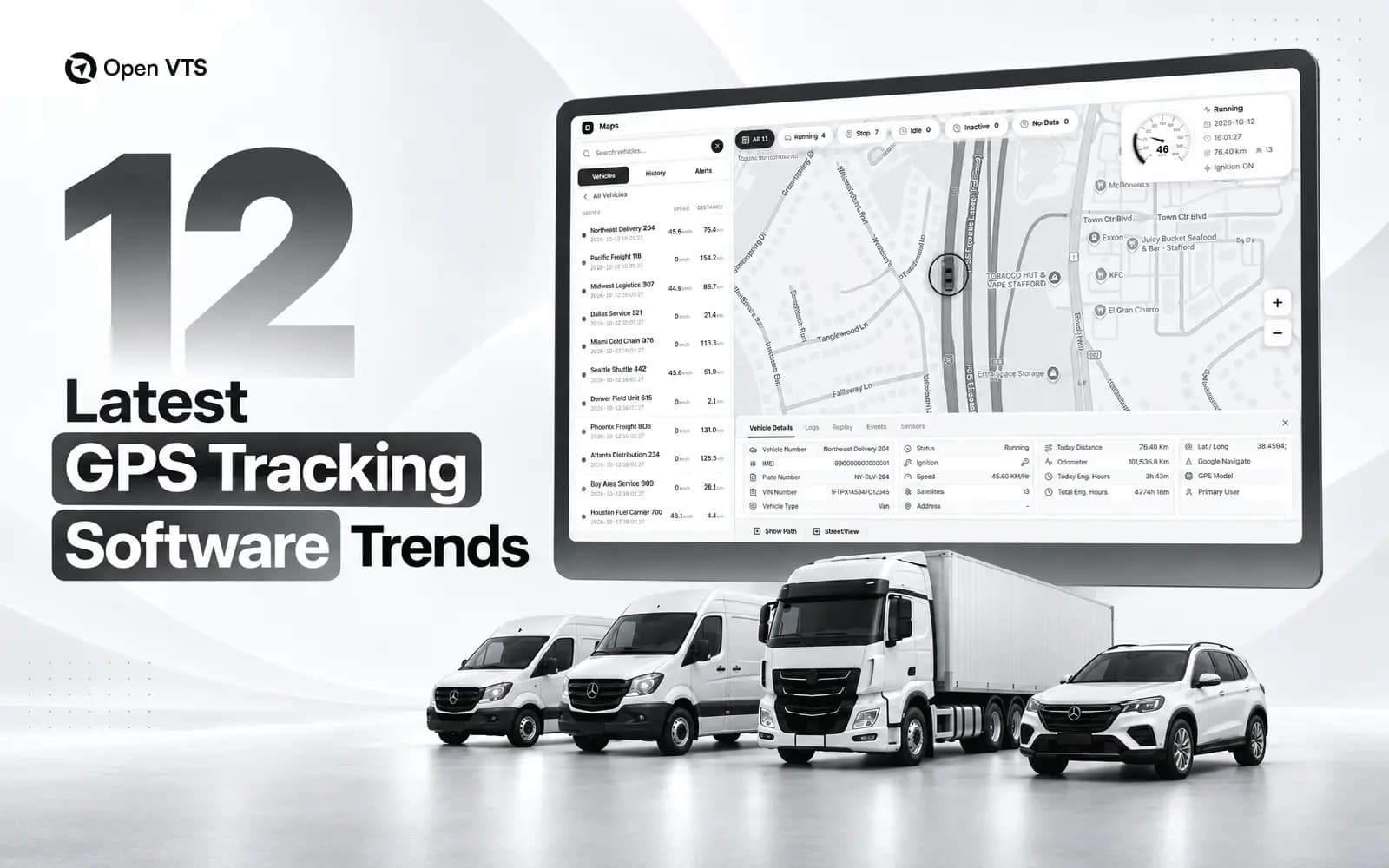
12 GPS Tracking Software Trends That Matter in 2026
Imagine a morning when every vehicle appears on the map, yet deliveries are slipping, an alert remains unread, and dispatch is still making calls to understand what happened. The locations are visible; the decisions are not. A useful tracking platform should help close that gap without creating more administrative work.
Open VTS approaches tracking through customer-controlled infrastructure, fleet visibility, workflows, and business administration. This guide examines twelve practical trends from that perspective. Some involve emerging AI applications; others are established capabilities to evaluate in 2026.
Better Decisions and Less Manual Work
Begin with the decisions your team struggles to make. Evaluate whether analytics, AI, and automation can address those specific gaps before expanding the feature list.
1. Operational Analytics Beyond the Map
To investigate recurring delays, look beyond individual journeys. Open VTS combines vehicle history, route playback, stop information, and activity reports. Use these records to identify locations associated with repeated waiting or vehicles with limited activity. Compare findings across a consistent reporting period before changing schedules or assignments, so the decision rests on patterns rather than assumptions.
2. AI With a Defined Purpose
The Open VTS documentation describes configurable access to external AI models, including fallback options. This establishes support for configured AI features, not automatic predictive maintenance or unrestricted conversational analytics. Evaluate the exact task being performed, check responses against known information, and review what data leaves your deployment. Useful AI should earn trust through demonstrated accuracy.
3. Workflows That Connect Events to Actions
Open VTS workflows combine incoming telemetry or schedules with conditions and supported actions, including notifications, reports, and external requests. A vehicle event can therefore initiate a defined response instead of another manual check. Build one process at a time, confirm its required data and integrations, and review execution results before relying on it operationally.
Richer Data and Practical Field Access
Consider visibility from the operator’s perspective, not just the dashboard. Check whether the required readings arrive consistently and whether authorized staff can use them where work happens.
4. Sensor Information Alongside Location
Open VTS processes supported sensor information alongside vehicle telemetry, with available fields depending on the device, protocol, and configuration. For temperature-sensitive transport, confirm that the required measurements reach the platform before creating rules around them. Check reading intervals and missing values during a pilot, rather than treating an absence of warnings as proof of acceptable conditions.
5. Hardware Flexibility With Verified Compatibility
Choose tracking hardware for the job, then verify compatibility. Open VTS supports multiple device protocols and publishes hardware and connection-port information. Test the exact model’s location reporting, sensor readings, and supported commands before purchasing at scale. Hardware flexibility is useful only when the equipment reliably supplies the information your operation needs.
6. Mobile Access Matched to Each Role
The Open VTS responsive application provides maps, trip timelines, and notifications through desktop and mobile browsers, with access shaped by assigned roles. Evaluate the everyday tasks that matter to supervisors and field teams, not simply whether a page opens on a phone. Confirm that relevant information is easy to find and unrelated vehicles remain inaccessible.
Stronger Response and Vehicle Readiness
Evaluate these capabilities through realistic situations: an unexpected route change, a driving incident, or a vehicle awaiting dispatch. Assign responsibility for investigating each result before deployment.
7. Geofence Alerts Connected to Response
A boundary crossing should begin an investigation, not disappear into an unread notification list. Open VTS supports geofence, overstay, and route-deviation alerts. Define who reviews each event, how they verify the circumstances, and when escalation is necessary. Test the complete response, measuring the time between notification delivery and informed action.
8. Video Telematics for Incident Review
Open VTS describes compatible dashcam integration that connects triggered footage with vehicle timelines, incident review, and coaching records. Assess the complete review process, including camera compatibility, upload behaviour, retention, and reviewer access. Use footage to investigate context and support constructive feedback rather than assuming every automated detection is correct or that camera installation guarantees safer driving.
9. EV Tracking for Dispatch Readiness
A vehicle beside a charger is not necessarily ready for dispatch. Open VTS’s EV offering describes battery-state visibility, charging events, and range estimates, dependent on compatible vehicles and hardware. Test against actual routes and charging routines, checking whether dispatch can identify interrupted charging before assignment. Examine estimation assumptions rather than treating available-range figures as guarantees.
Connected Systems and Greater Platform Control
Look beyond daily tracking when evaluating long-term suitability. Consider how information moves between systems, how customers are managed, and who maintains the deployment.
10. APIs That Reduce Manual Transfers
Open VTS provides documented REST APIs and real-time communication interfaces for supported integrations. Use a pilot to demonstrate one complete handoff, such as transferring vehicle information into an internal operations system. Check permissions, error handling, and ongoing maintenance responsibilities. API access supplies integration building blocks; it does not mean every business application connects without additional work.
11. Self-Hosted, Branded Tracking Operations
Open VTS supports customer-controlled deployment, multi-level accounts, and supported branding configuration, making it relevant to businesses operating their own tracking service. Evaluate customer administration and access management alongside appearance. Confirm edition limits, customization rights, and operating responsibilities before committing; control over infrastructure and branding should not be confused with unrestricted ownership of the software itself.
12. Data Governance Built Into Operations
Open VTS’s self-hosted model lets customers control their deployment while assigning important security responsibilities to the operator. Establish access boundaries, retention policies, backup testing, updates, and recovery procedures. Review external integrations separately, especially when information leaves the server. Self-hosting provides control, but maintaining a dependable environment requires someone to exercise that control consistently.
Turn These Trends Into a Practical Decision
Choose one costly problem, agree on success criteria, and test with representative vehicles and staff. Use the table to select a starting point rather than attempting every capability simultaneously.
| Business priority | Suggested pilot | Evidence to collect |
|---|---|---|
| Reduce repetitive work | Scheduled reporting workflow | Manual steps removed |
| Improve incident response | Geofence notification process | Alert-to-action time |
| Connect business systems | One API integration | Successful data transfers |
| Improve EV availability | Charging and dispatch checks | Problems found before assignment |
Compare results with your existing process and include installation, connectivity, integration, and administration costs. The strongest reason to expand is not another feature becoming available; it is evidence that your team can make a better decision with less uncertainty. Choose tracking that helps you keep the business moving, not simply watch it move.