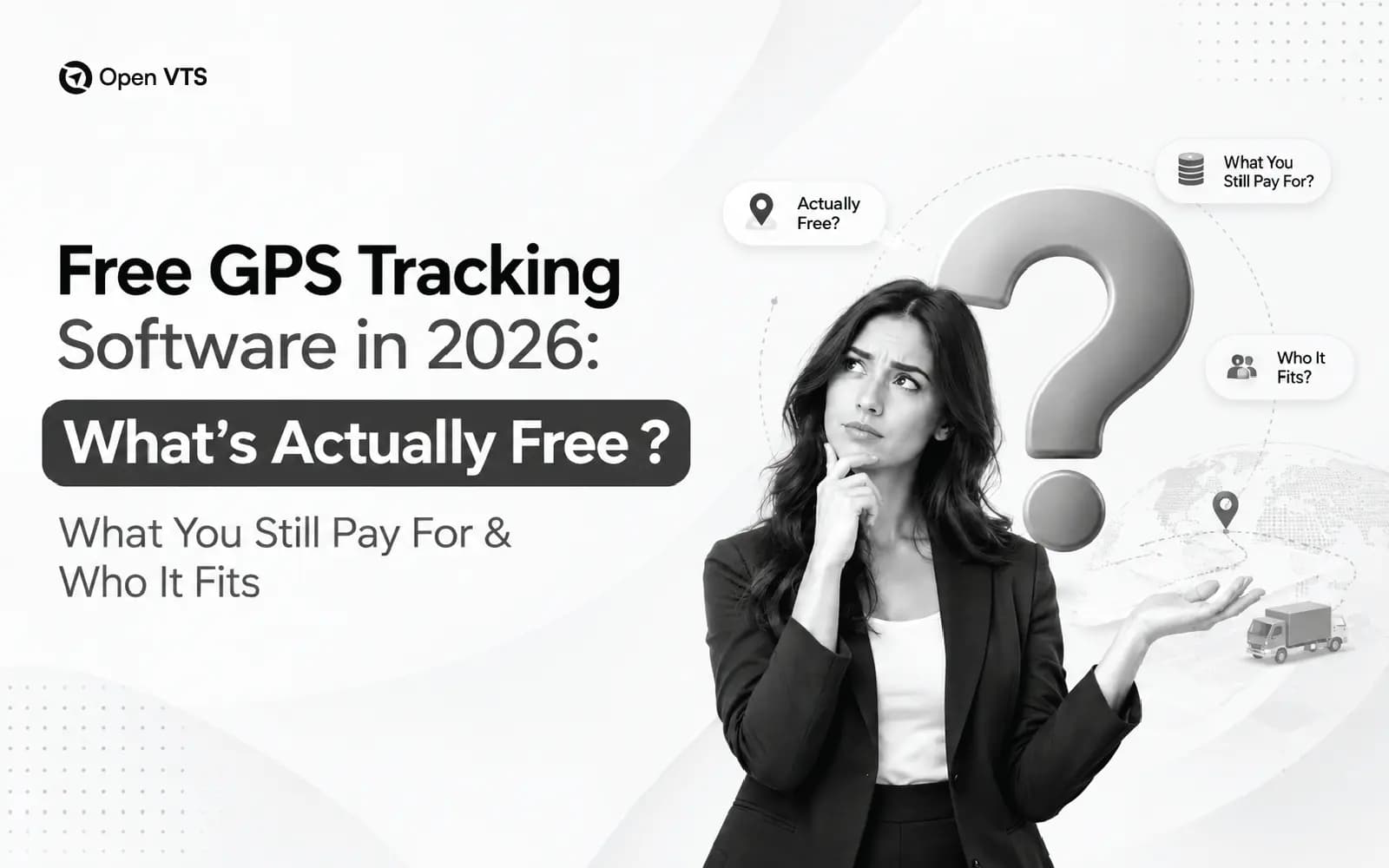
Free GPS Tracking Software in 2026: What's Really Free?
Free GPS tracking software can genuinely remove the software-license fee, but it rarely makes an entire vehicle-tracking operation cost nothing. GPS satellite signals are free to receive; hardware, cellular data, servers, maps, and support may still cost money. To find a useful free solution, check what remains available after a trial ends, which features and vehicles are covered, and who controls the records. A clearly defined free tier can be valuable without pretending that every component is included.
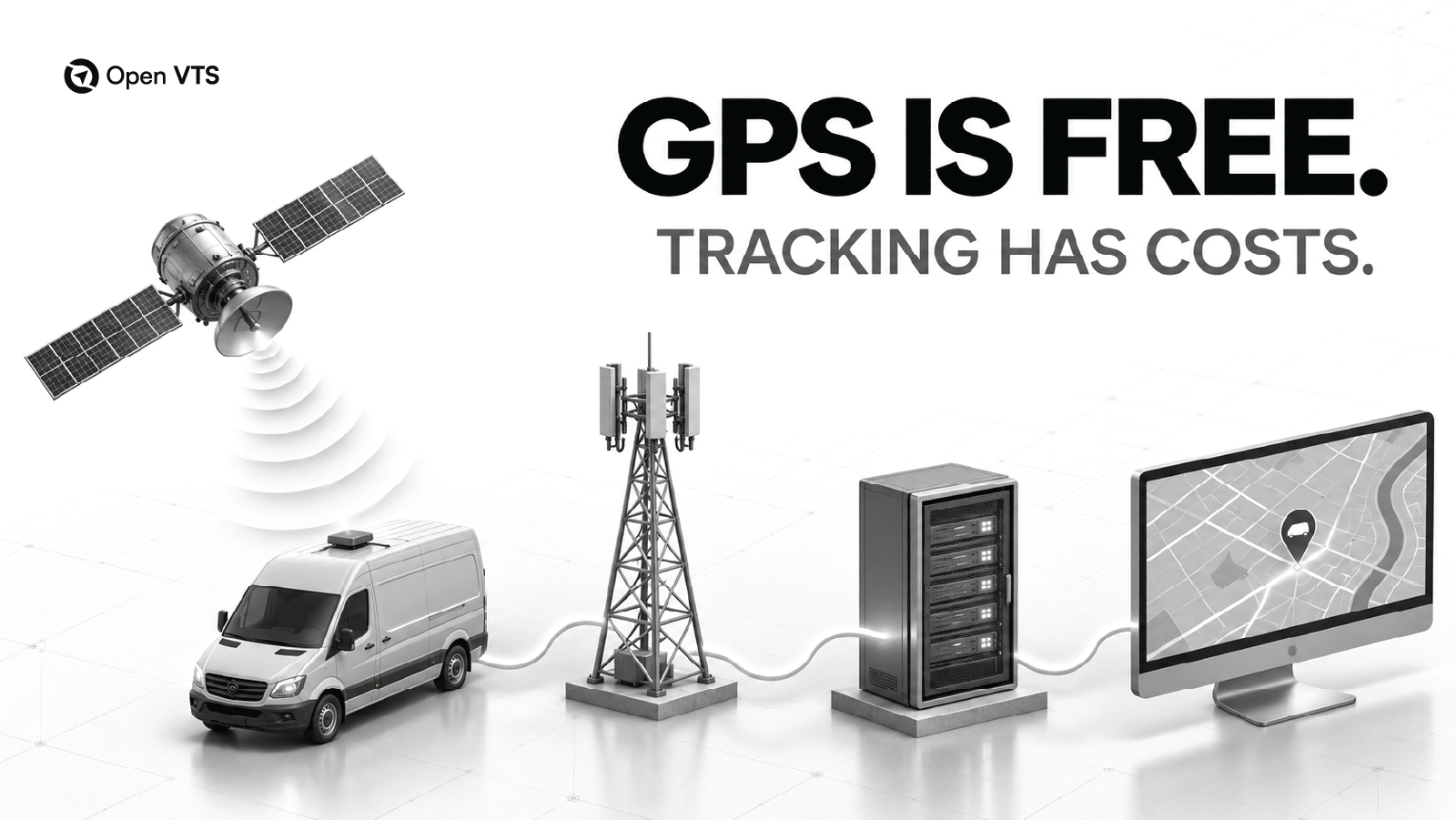
GPS Is Free. A Complete Tracking Service May Not Be.
The US government provides civilian GPS service without direct user fees. A GPS receiver uses satellite signals to calculate a position; satellites do not automatically upload that position to a business dashboard. Remote fleet tracking generally adds a device or phone, a communications connection, a server or managed service, and software for maps, history, alerts, and user access. The equipment and operations behind those stages have their own economics.
A free map or a phone's location-sharing feature may serve a personal need without satisfying business fleet requirements. If you operate several vehicles, ask whether the system receives telemetry from the actual trackers, maintains usable history, separates employee permissions, and allows appropriate reporting. The relevant question is not simply whether an application is free to install, but whether the complete workflow you need can continue operating under its free terms.
Six Different Meanings of "Free GPS Tracking Software"
A free trial gives access for a stated evaluation period. It may demonstrate a complete paid service, but continuing after the deadline can require payment. A free demo may show sample vehicles or a controlled environment without permitting an independent production deployment. Neither is inherently misleading when the time or usage boundary is disclosed.
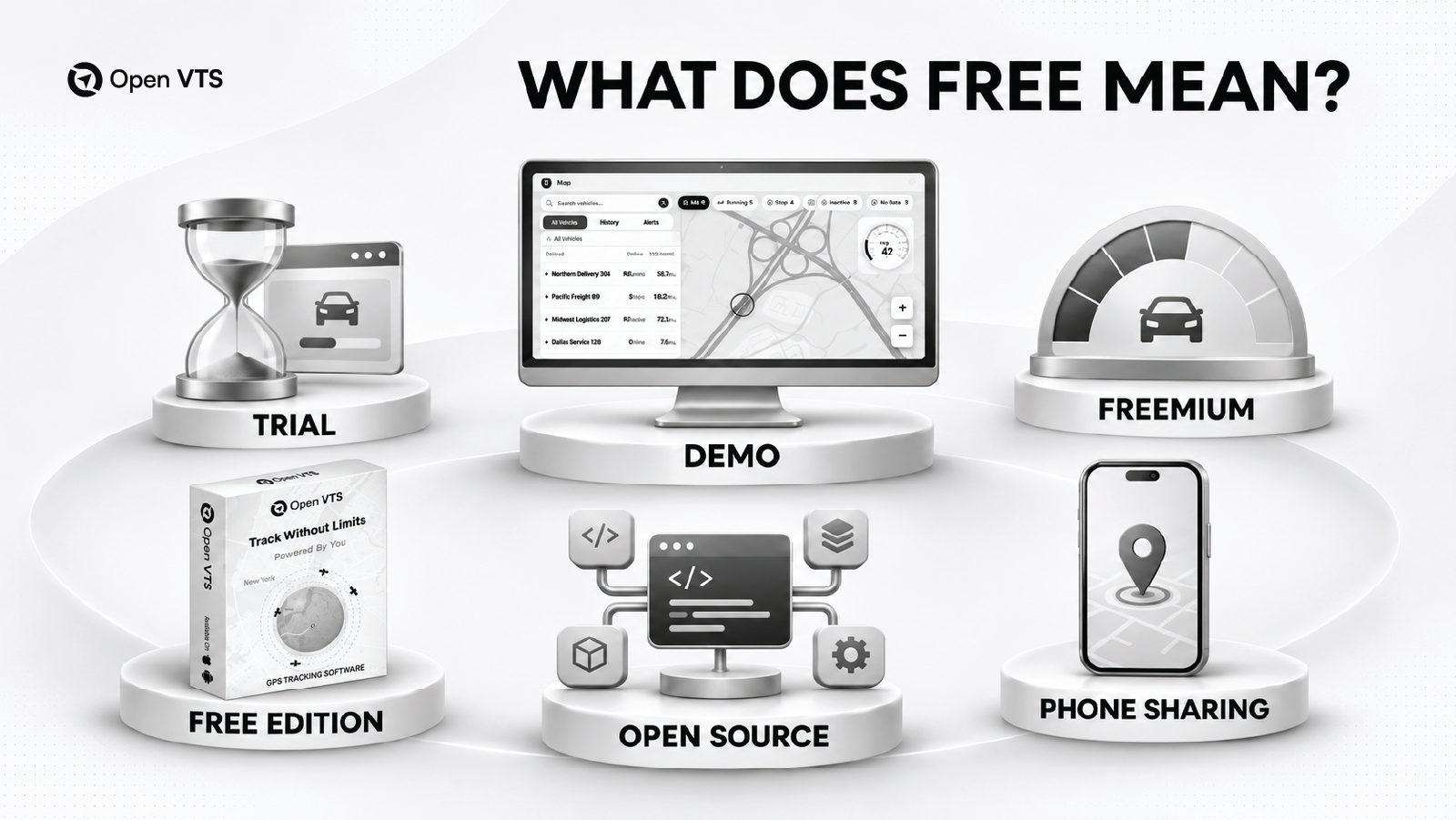
A freemium plan remains available at no software charge within defined limits, with upgrades for additional vehicles, users, storage, history, or functions. A permanent free commercial edition can also last without a trial countdown while remaining under a proprietary license. Whether features are restricted depends on the actual offer; free commercial software is not automatically a stripped-down demo.
Open-source software is different: the applicable license grants defined freedoms concerning source code, modification, and redistribution. That is not the same as a promise of free hosting, free technical support, or effortless maintenance. The Open Source Initiative specifically distinguishes open-source rights from mere source-code visibility.
Finally, free phone location sharing or basic fleet administration may show a person's position or track vehicle service records without accepting continuous telemetry from dedicated GPS trackers. Those tools can be useful, but they should not be counted as equivalent to a full GPS fleet-tracking platform. Choose by the required function, not by a "free" label or an attractive map screenshot. A business also needs to know whether the arrangement supports multiple authorized employees and gives them the right level of access.
The Restrictions That Define a Free Plan
Before installing software, check the license's duration, vehicle ceiling, permitted users, history retention, exports, and available core modules. Ask whether live location, alerts, geofences, reports, and API access are included, limited, or entirely dependent on another product. A plan advertised as "free forever" can still have a fixed capacity: no expiration and unlimited vehicles are different promises.
Check the support entitlement and the consequences of declining paid assistance. Community documentation is not equivalent to contracted response times or on-site installation. Also inspect commercial-use rights. Permission to track your company's own fleet is not automatically permission to resell the platform, redistribute builds, or publish branded applications for customers. A reliable free offer states these boundaries plainly and provides a path to the current terms.
Hardware, SIMs, Servers, and Maps Still Have Costs
A physical tracker must obtain observations and get them to the receiver. For cellular hardware, that normally means an appropriately provisioned SIM or equivalent connectivity, a compatible modem, and coverage where vehicles operate. Different device models may require different protocols and firmware settings. Test an actual device instead of assuming that appearance in a compatibility catalogue guarantees every sensor, alert, or command works.
Self-hosted software needs an operating environment: a suitable computer or server, storage, network configuration, access controls, backups, monitoring, and someone responsible for recovery. An inexpensive server quote is not evidence that the configuration can sustain your reporting frequency and fleet workload. Map data can be openly available while hosted tiles, routing, geocoding, or commercial service levels carry separate usage restrictions or charges. Public map-tile infrastructure should not be treated as unlimited production hosting.
Factor in installation, power, device replacement, text notifications, staff time, and any optional integrations. Some expenses are paid monthly; others arise at installation or during incidents. A zero-dollar license can be a meaningful benefit precisely because it removes one expense, not because it eliminates everything else.
The True-Free Receipt: Eight Questions to Ask
Use this True-Free Receipt before choosing any advertised free GPS option. The columns describe what a buyer should verify, not a standardized product certification.
| What to inspect | What a satisfactory answer establishes |
|---|---|
| License | Whether continuing core software use costs $0 |
| Duration | Whether a deadline, renewal, or trial cutoff applies |
| Capacity | Allowed vehicles, users, and relevant storage limits |
| Functionality | Tracking, history, geofences, alerts, reports, and needed integrations |
| Operating expenses | Responsibility for hardware, SIMs, servers, maps, and backups |
| Support | Included guidance, updates, and any paid assistance |
| Rights and data | Permitted business use, hosting custody, exports, and source-code rights |
| Growth and exit | Upgrade costs, data continuity, and migration restrictions |
Mark each result included, excluded, conditional, or VERIFICATION REQUIRED. A promised capability should be tested under the installed version, not assumed from a category name. Particularly for location data, verify who can see records, where they persist, and what happens when an account or sharing permission is revoked. A complete receipt lets buyers distinguish a genuine free software entitlement from a separately billed operating service. Save a copy of the terms you relied on when making your decision.
What Would Free GPS Software Cost for 25 Vehicles?
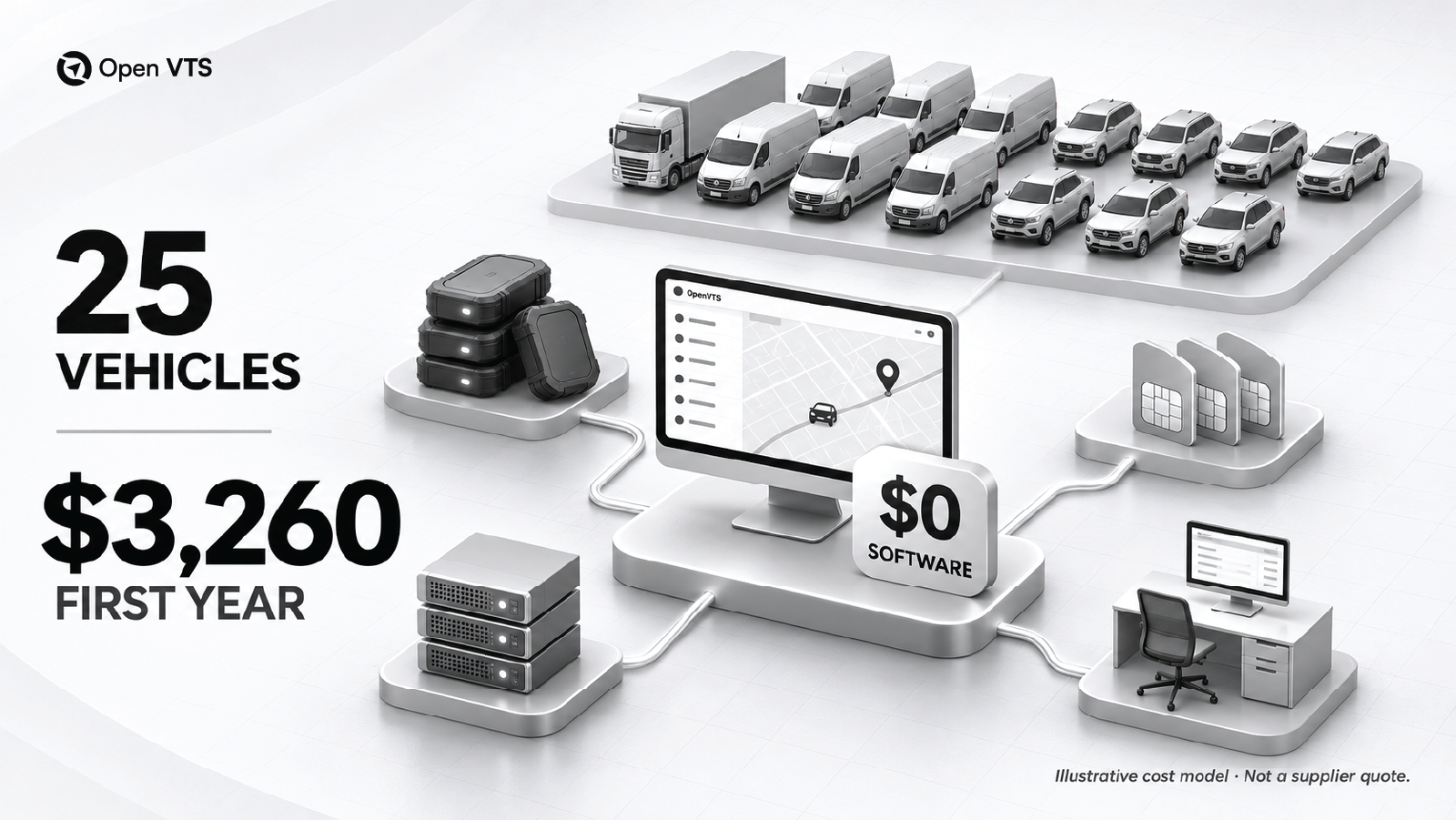
Consider a hypothetical 25-vehicle business using a qualifying $0 software license. Suppose each tracker costs $50 upfront, each SIM costs $2.50 monthly, hosting costs $20 monthly, backup and monitoring cost $10 monthly, and administration takes three hours monthly valued at $25 per hour. These are arithmetic assumptions, not current supplier quotations, tested server requirements, or a measure of Open VTS performance.
| Cost component | Illustrative amount |
|---|---|
| Software license | $0 |
| Twenty-five trackers | $1,250 upfront |
| SIM/data | $62.50 per month |
| Server hosting | $20 per month |
| Backup/monitoring | $10 per month |
| Administration | $75 per month |
| Recurring resource cost | $167.50 per month |
The first-year modelled total is $3,260: $1,250 of hardware plus twelve months of recurring costs. Across 36 months it becomes $7,280, or about $8.09 per vehicle per month when the upfront hardware purchase is allocated over the period. Installation, taxes, repairs, unusual data use, and other optional services are excluded. Administration is valued resource time, not necessarily additional cash payroll. None of these figures is a fee charged by the free-software provider.
The lesson is not that free tracking costs $8.09 per vehicle. It is that the same $0 license can produce different total costs depending on devices, reporting intervals, hosting, support expectations, and internal staff. Replace every assumption with a quote or measurement before budgeting or authorizing any larger production fleet rollout.
Licensing, Privacy, and Data Ownership
A free download can be commercially licensed. Open-source licensing, proprietary freeware, and customer-operated hosting answer different questions. A business may control its fleet database and servers without receiving copyright or modification rights to the underlying platform. Review the license before redistributing software or offering a white-label tracking service.
Self-hosting places important security decisions with the operator, including administrative access, backups, encryption arrangements, monitoring, and retention. Location histories can reveal workers' routines and customer sites. Use appropriate notice and permission policies, restrict access by role, and test exports and account revocation. A private deployment is not automatically a compliant or secure one. Similarly, a mobile map hiding old positions does not prove that records have been removed from logs or backups.
How Open VTS's Free 50-Vehicle Tier Works
Open VTS offers a specific type of free GPS tracking software: a commercially licensed, self-hosted core platform with a published $0 tier for 0–50 vehicles. Thereis no trial expiration, no credit card requirement, and full core-platform feature access, with community support. The download documentation lists live tracking, trip history, geofences, alerts, and reporting as included capabilities.
That combination is meaningful for a small business or technical team seeking a genuine fleet-software evaluation without a software-license countdown. The organization chooses and operates the server environment and controls normal production tracking-data storage, subject to external services it elects to use. Support to create server and install Open VTS on windows and Linux is given for everyone.
The free entitlement does not supply trackers, SIM plans, hosting, guaranteed priority support, or unrestricted commercial redistribution. Nor does it make the proprietary main platform open source. Core feature availability should be distinguished from optional professional services, hardware-dependent functions, and actual performance. The best way to judge suitability is to install the supported release, connect an authorized compatible tracker, and verify the workflow you need.
What Happens When You Need a 51st Vehicle?
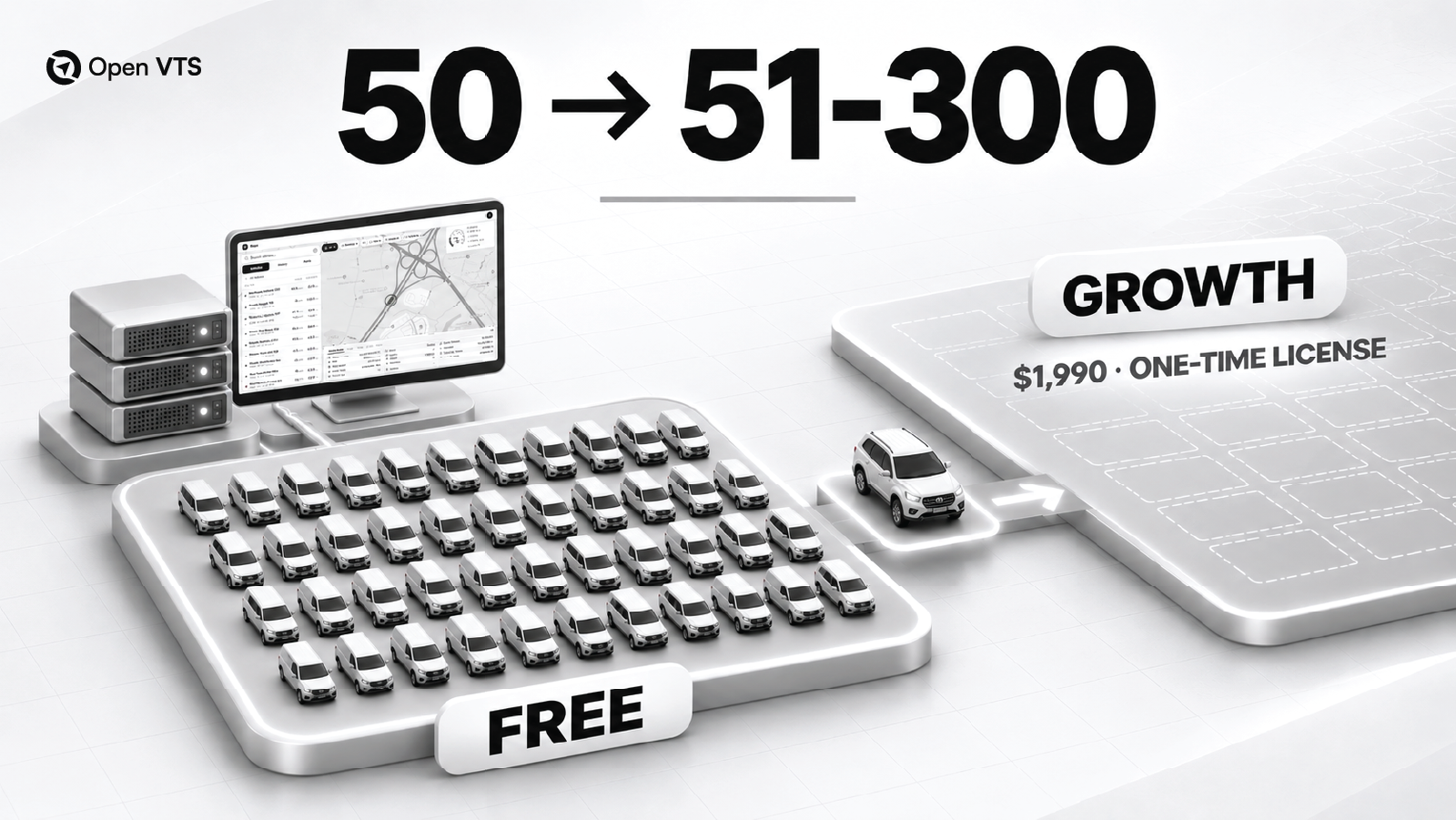
A non-expiring tier can still have a ceiling. Open VTS's published Free tier ends at 50 vehicles; its Growth license covers 51–300 vehicles at a published $1,990 one-time license price. Its pricing says upgrades to a higher tier can be made by paying the difference. The license transition is distinct from any server upgrade, installation assistance, or support agreement the business might need.
Check Pricing of Open VTS here.
Before activating vehicle 51, confirm the exact entitlement, the installed version's upgrade procedure, and continuity of devices, users, integrations, and history. No general compatibility or zero-downtime migration guarantee follows from the price table alone. Ask how older history and settings will remain accessible after the license change.
Seven Checks Before Relying on Free GPS Tracking Software
- 1Verify the actual free terms. Record license price, expiration, vehicle limit, included modules, support level, and permitted business use from current documentation.
- 2Prove telemetry ingestion. Connect one authorized device and confirm current valid positions, not merely an online icon or a successful socket connection.
- 3Test historical use. Check trip history, geofences, alerts, reporting, and the timestamps behind displayed locations.
- 4Price the complete operation. Obtain actual quotes for devices, SIMs, hosting, backups, administration, and any mapping or integration services.
- 5Test access and recovery. Give users restricted roles, interrupt a device connection, and verify authorized visibility, buffered history where supported, and backup restoration.
- 6Review your data rights. Confirm storage custody, exports, retention, allowed commercial activity, and any restrictions on migration or redistribution.
- 7Plan beyond the free limit. Model your next capacity tier and validate technical readiness before the fleet grows beyond the entitlement.
A useful free platform is one that performs the required work within clear boundaries not one with the most dramatic "free forever" slogan. If your fleet has up to 50 vehicles and you want control over its tracking infrastructure, explore the Open VTS free downloadand test one compatible vehicle first. The license can be genuinely free while the operating responsibilities remain yours.