GPS Tracking Companies & Providers: How to Choose the Right Partner in 2026
Choosing a GPS tracking provider can shape your business long after the first device is installed. A low monthly price and an attractive vehicle map tell you very little about who will fix connection failures, protect customer history, support new hardware, or help you grow.
This guide explains what GPS tracking companies actually supply, the requirements every tracking business should establish, the commercial traps to investigate, and the technical limits to test. It also shows when operating your own platform with Open VTS may give you a stronger foundation for building a lasting GPS tracking business.
What Do GPS Tracking Companies Actually Provide?
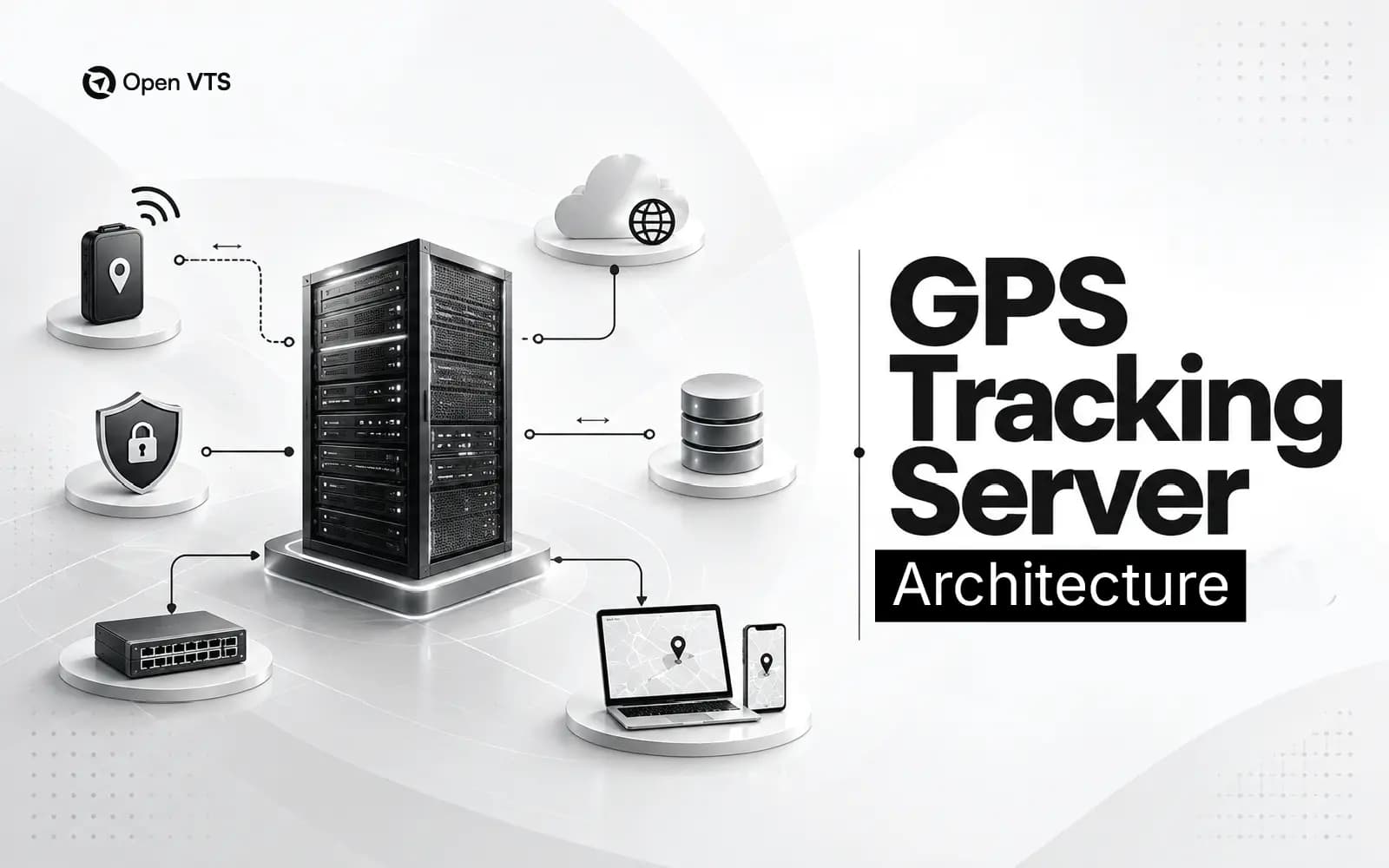
A GPS tracking service is more than a website with moving vehicle icons. A typical installation includes a position source in the vehicle, cellular or another communications service, a receiving server, software that decodes and stores observations, and interfaces for customers and support teams. Depending on the vehicle and hardware, the system may also supply ignition, engine, or sensor information. The US Department of Energy describes telematics as a combination of vehicle data collection, communication, software, and fleet-management processes not simply satellite location.
Not every company supplies or manages every component. Some sell hardware, others install and configure devices, and others operate software or provide a complete managed service. A GPS tracking entrepreneur often combines several suppliers to deliver one customer experience. Before signing an agreement, identify the owner of each component and the party responsible when it fails.
| Part of the service | What it includes | Question to settle |
|---|---|---|
| Hardware | GPS devices, wiring, optional sensors | Who replaces a faulty tracker? |
| Connectivity | SIMs, plans, network configuration | Who resolves data-session failures? |
| Installation | Fitting, configuration, testing | Who corrects installation faults? |
| Software | Live map, history, alerts, reports | Who maintains protocols and features? |
| Infrastructure | Servers, databases, backups | Who monitors and restores the system? |
| Customer operations | Onboarding, accounts, support | Who owns an unresolved incident? |
This is the Provider Responsibility Map. A provider delivering an all-inclusive service may handle most items. If you operate a tracking business yourself, the responsibilities may be distributed among your company, infrastructure operator, connectivity supplier, and software developer. The important outcome is a named owner and escalation path for every failure not six suppliers pointing at one another.
Know Your GPS Tracking Business Requirements Before You Buy
Start with the business you want to operate, not the feature list a salesperson presents. Identify your first customer segments, likely vehicle numbers, GPS hardware already in use, coverage regions, support hours, and growth expectations. A ten-vehicle delivery fleet may emphasize timely positions and dispatch visibility; a GPS tracking company serving dozens of customers needs account separation, renewals, inventory, and technical troubleshooting. A trucking business might also require a separately verified regulatory solution. General location tracking is not automatically an FMCSA-registered electronic logging device.
The following twelve requirements cover the essentials of a sustainable GPS tracking business. Treat an item as mandatory if failure would prevent you from serving customers, meeting an applicable obligation, or recovering your operations. Optional features should not compensate for missing essentials.
| Area | Requirements to establish before purchase |
|---|---|
| Tracking operations | 1. Exact device/protocol compatibility, 2. fresh locations and reliable history 3. geofences, alerts, reports, and required commands 4. usable web and mobile workflows. |
| Business administration | 5. Separate customer accounts and role-based permissions 6. device, SIM, and vehicle inventory 7. customer plans, renewals, billing, and support records 8. branding and applicable commercial-use |
| Technical independence | 9. APIs and required integrations 10. data access, exports, retention, and backups 11. measurable capacity, recovery, and maintenance responsibilities 12. transparent total costs and upgrade or migration terms. |
Turn each requirement into an acceptance test. If fuel or temperature monitoring is essential, verify that your actual device sends the required data and the software interprets it correctly. If you plan to serve independent customers, create two test accounts and check that neither can access the other's vehicles or history. If you expect to change providers later, obtain a sample export with meaningful timestamps and device identifiers. These practical checks are more valuable than counting features on a brochure.
How GPS Tracking Providers Can Mislead Buyers: What Goes Wrong After Purchase
A disappointing purchase does not always involve deliberate deception. Problems often begin with statements that sound complete but have narrower meanings in the contract or technical documentation. “Compatible with your trackers” may mean the platform recognizes basic coordinates but not the fuel sensor or engine command you need. “Unlimited vehicles” may refer to licensing while the installed server has finite processing capacity. “All features included” may exclude third-party mapping, specialized hardware, or custom integrations. Buyers who accept these phrases without written definitions discover the limits only after installation and customer onboarding.
Consider a hypothetical GPS business that buys devices, signs up forty customers, and later learns that useful historical exports are difficult, the branded application needs an additional agreement, or support escalations have no committed response time. Its real loss is not just an extra charge. It may face repeated service calls, customer dissatisfaction, reinstallation work, and expensive migration. Reduce that exposure by asking for written scope, an itemized quotation, a real-device pilot, and a complete explanation of what happens when the contract changes or ends.
| Attractive promise | What to request before payment | |
|---|---|
| All GPS devices supported | Exact model, firmware, protocol, and required-field test |
| Real-time tracking | Observation timestamps and defined freshness behaviour |
| Full ownership | Written distinction between data custody, hosting, and software rights |
| White label included | Domains, app scope, branding rights, and any added charges |
| Unlimited growth | License terms plus measured infrastructure capacity |
| Support included | Hours, responsibilities, escalation, and response commitments |
Price deserves the same scrutiny. Compare the complete three-year arrangement: device purchase or rental, installation, SIMs, software licensing, hosting, storage, backup, mapping, technical support, administration, integrations, and possible migration. Neither a low monthly rate nor a one-time license by itself establishes the cheaper operating model. Compare identical service boundaries, and avoid treating staff time or excluded components as though they cost nothing.
GPS Tracking Software Limitations Providers Don't Always Explain Upfront
Every GPS tracking system has technical boundaries, including self-hosted systems. Begin with data freshness: a tracker may observe a position, send it later, and have the interface display it later still. A map refreshing every second does not prove the underlying location is one second old. Cellular gaps, weak satellite reception, device configuration, delayed processing, and reconnect behavior all affect what customers see. GPS.gov identifies signal blockage, reflections, and receiver design as important positioning limitations. Test actual observation times, server receipt times, and stale-position handling rather than trusting animated markers.
Next examine compatibility and scale. A published device catalogue does not guarantee that every firmware version, sensor value, alarm, or command is supported. A permitted vehicle count does not prove how many simultaneous connections, telemetry updates, report queries, or dashboard users a particular server can sustain. Ask for a test using realistic reporting intervals and a representative mix of moving and stationary vehicles. Test interruptions too: buffered history should be handled distinctly from genuinely current vehicle state, and the reporting workload should not silently degrade tracking ingestion.
APIs, security, and retention also have boundaries. An advertised API may impose request, export, or date-range limits; a button hidden from a user does not establish server-side authorization. OWASP( Open Worldwide Application Security Project) warns that object-level authorization failures can expose records through otherwise authenticated endpoints. Ask where history, reports, exports, logs, and backups reside, who can retrieve them, and how access changes when a customer leaves. Software is suitable only when these limitations are known and acceptable to your business not when a provider claims they do not exist.
Seven Questions to Ask Before Paying a GPS Tracking Provider
Convert the concerns into a written provider-evaluation exercise. Ask each shortlisted company the same seven questions, request practical evidence, and keep the answers with the quotation. This gives you a defensible comparison and protects the business from discovering essential limitations after customers depend on the platform.
- 1Will my exact GPS devices work? Demonstrate the model, firmware, telemetry fields, alarms, and commands actually required.
- 2How fresh and complete is the tracking data? Show source timestamps, missing-data behavior, reconnections, and historical replay.
- 3Can separate customers access only their own information? Test user roles, live views, reports, exports, and APIs using restricted accounts.
- 4Who operates and protects the infrastructure? Identify server ownership, backups, monitoring, security updates, and the recovery owner.
- 5Can I integrate and move my data? Demonstrate the necessary API workflow, document limits, and provide a usable export.
- 6What is the real three-year cost? Include hardware, installation, SIMs, licensing, hosting, support, add-ons, growth, and exit charges.
- 7What happens when something fails or our relationship ends? Get the escalation process, support commitments, customer continuity plan, and contractual rights in writing.
Do not judge the answers by presentation quality alone. A useful trial tests real vehicles, independent customer accounts, and at least one failure scenario. Record what passed, what failed, and what remains unsupported before you commit to a long-term relationship.
How Open VTS makes you limitless ?
Choosing GPS tracking software should not mean accepting unnecessary restrictions on your business, customer relationships, infrastructure, or future growth. Open VTS is designed around a different approach: Track Without Limits, Powered by You. As a self-hosted platform, it allows you to operate GPS tracking software on infrastructure you control, administer your operational data, manage customer accounts, configure integrations, and establish your own business identity. Instead of relying entirely on a third-party-hosted dashboard, you can manage important parts of your tracking operation directly.
The platform supports Superadmin, Admin, User, Subuser, Team, and Driver roles, with configurable permissions that help determine which vehicles, reports, alerts, and actions each person can access. For a GPS tracking company serving multiple customers, this hierarchy provides a structured foundation for customer administration, device and SIM inventory, vehicle assignments, service plans, renewals, and account management. Open VTS also publishes a broad GPS device-protocol catalogue and documented APIs, allowing businesses to evaluate hardware compatibility and integrations without developing the entire tracking platform from scratch.
Beyond basic tracking, Open VTS includes operational tools intended to help businesses turn vehicle data into useful decisions. Its Operations module provides a dashboard for reviewing trips and their progress, driver-related information, a calendar for planning activities, and recurring-trip management. These capabilities help fleet operators organize assignments, monitor planned journeys, and identify trips requiring attention instead of relying only on calls and manual coordination.
Its Workflow Automation module extends this approach by allowing supported GPS events and scheduled activities to trigger configured actions. For example, a geofence exit, overspeed event, or another supported condition can be connected to email, mobile notifications, or other configured delivery channels. Workflows can also incorporate scheduled reports, supported device commands, and API-based integrations with external business systems. Available actions depend on the selected GPS hardware, integration credentials, and deployed configuration. Together, Operations and Workflow Automation help a GPS tracking business deliver more than vehicle locations: they provide tools for coordinating journeys, responding to exceptions, and automating repetitive processes.
One particularly useful capability is simultaneous vehicle movement visualization on the live map. Rather than requiring an operator to open vehicles individually to observe movement, Open VTS can display multiple authorized vehicles in the same map view, with independently updated markers and smooth visual transitions between received GPS positions. Vehicle status, direction, speed, and last-update information help operators understand activity across their fleet, while clustering can keep a crowded map readable. These animations improve visual continuity; they do not manufacture new GPS observations or guarantee that every vehicle is updating every second. Businesses can combine this fleet visibility with historical replay, geofences, alerts, reports, supported commands, and controlled sharing to provide a more complete tracking experience.
Open VTS also offers a free core software tier for up to 50 vehicles and one-time paid vehicle-capacity licenses, without recurring base per-vehicle license charges within the applicable tier. Hardware, connectivity, hosting, support, and technical capacity remain separate considerations, while resale and white-label rights follow the applicable agreement.
The real advantage is not a promise that technology has no limits; it is the ability to build and operate a GPS tracking business with greater control over its infrastructure, customers, operational workflows, integrations, and long-term software costs.
Conclusion: Build Your GPS Tracking Business on a Platform You Can Control
The right GPS tracking provider should do more than offer an attractive dashboard and convincing sales promises. Your business needs reliable vehicle visibility, compatible hardware, customer management, appropriate permissions, useful operational tools, automation, transparent licensing, and a clear understanding of who controls its tracking environment.
Open VTS brings these capabilities together in a self-hosted platform designed for GPS tracking businesses, fleet operators, and technology providers who want to establish their own operations without developing the entire software system themselves. With simultaneous fleet-map visibility, Operations, Workflow Automation, role-based administration, documented integrations, and a free entry point for up to 50 vehicles, it offers a practical foundation to evaluate. Explore Open VTS, connect your GPS devices, and experience the platform on infrastructure you control.