Open Source vs Source-Available vs Self-Hosted GPS Software: A Practical Ownership Guide
Terms such as open source, source available, and self-hosted are often used interchangeably in GPS software discussions, but they describe different things. That distinction matters because a buyer can easily believe they are purchasing “full ownership” while actually receiving only source visibility, a deployment license, or control over the server environment. Open source describes the rights granted by a qualifying software license. Source available describes access to source code under terms that may restrict how it can be used. Self-hosted describes who operates the software and infrastructure. These concepts can overlap, but none automatically guarantees software copyright ownership, complete source access, unrestricted commercial use, or total data independence.
First: These Are Three Different Questions
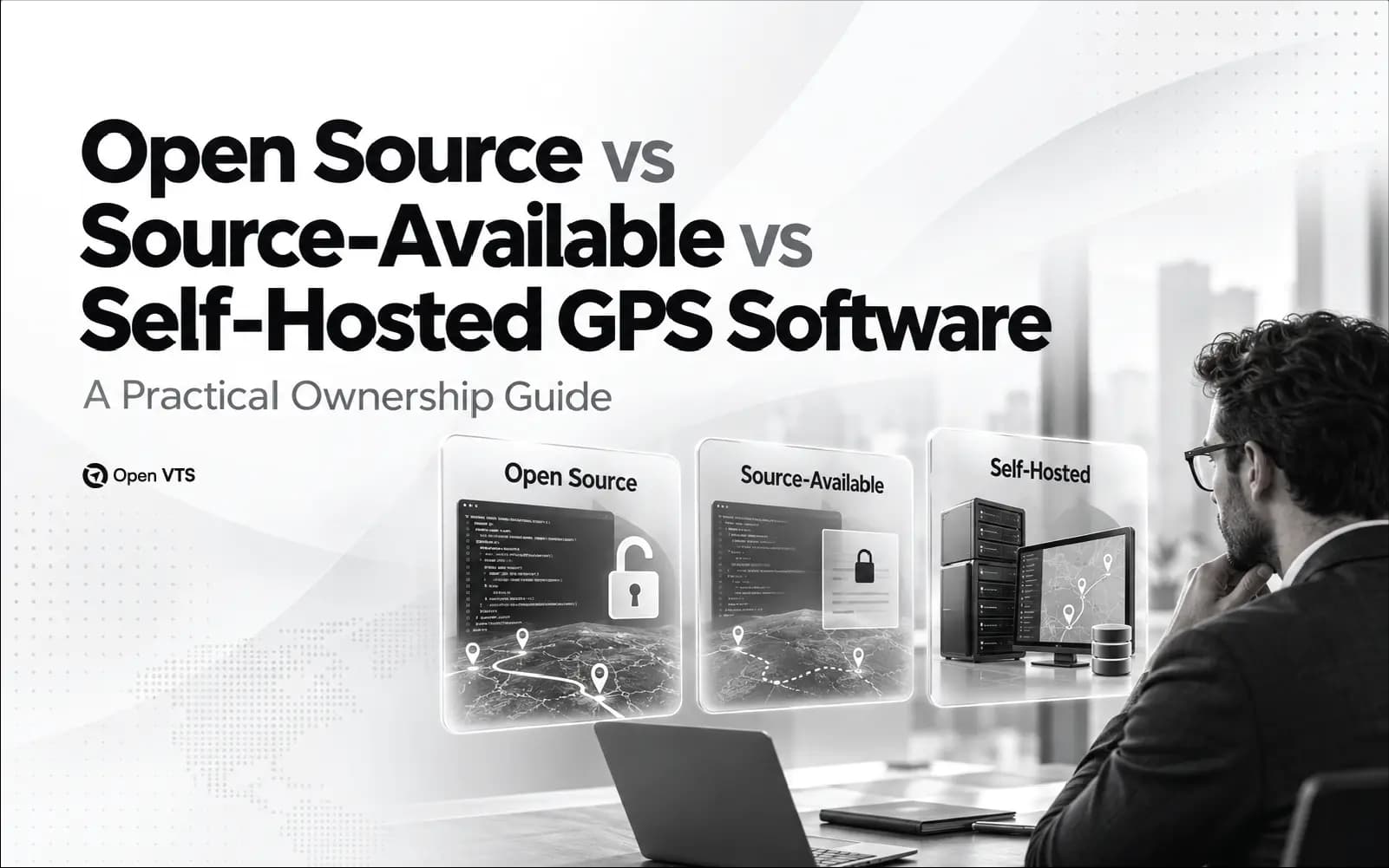
The easiest way to understand the difference is to stop treating open source, source available, and self-hosted as three competing product categories. Open source and source available primarily concern software rights and source access, while self-hosting concerns deployment and operational control. A product can therefore be both open source and self-hosted, source available and self-hosted, or commercially licensed and self-hosted.
| Concept | Main question it answers | What it does not automatically guarantee |
|---|---|---|
| Open source | What does the license allow me to use, modify, and redistribute? | Hosting control, support, or low operating cost |
| Source available | What code can I inspect under the applicable license? | Open-source rights or unrestricted commercial use |
| Self-hosted | Who operates the application and infrastructure? | Source-code access or software copyright ownership |
This is the core ownership principle: license rights, source access, and deployment control should be evaluated separately.
What Open Source Actually Means
The Open Source Initiative makes the definition clear: open source does not simply mean that the source code can be viewed. The software's distribution terms must meet the Open Source Definition, which includes requirements around source availability, redistribution, derived works, and nondiscrimination. Open-source software can also be used commercially; “open source” and “noncommercial” are not synonymous. This gives users meaningful legal freedoms, but those freedoms still operate within the terms of the specific license.
Some open-source licenses are permissive, while others use copyleft provisions that create obligations when covered modified software is distributed or provided under certain conditions. For a GPS company planning a white-label product, commercial hosted service, or heavily modified platform, the exact license matters as much as access to the repository.
What Source-Available Actually Means
“Source available” is a broad industry term for software whose source can be inspected under a license that does not necessarily satisfy the Open Source Definition. There is no single universal source-available license, which means the actual rights can vary substantially. A source-available license might allow modification and development use while restricting production deployments, competing hosted services, redistribution, or other commercial activities. The Business Source License provides a useful licensing example.
Its text allows source access, modification, derivative works, redistribution, and non-production use while allowing the licensor to define additional permitted production use. Importantly, the license explicitly states that it is not an open-source license during its restricted period, even though the source is available, and provides for a later transition to an open-source license. For buyers, the practical rule is simple: never infer rights from the phrase “source code available.” Read the actual license and identify what it permits for production use, modification, redistribution, commercial hosting, and derivative products.
What Self-Hosted Actually Means
Self-hosting answers a different question: who controls and operates the runtime environment? A self-hosted GPS platform normally runs on infrastructure selected or controlled by the customer rather than exclusively inside a provider-operated SaaS environment. That infrastructure may be an on-premises server, private data center, dedicated server, VPS, or cloud instance; the organization does not need to physically own the hardware for the application to be operationally self-hosted. NIST's cloud definitions help clarify the responsibility boundary.
In SaaS, the provider operates the application and underlying infrastructure, while the customer generally has only limited application-level configuration. Under an IaaS-style model, the customer can control operating systems, storage, and deployed applications even though the cloud provider owns the underlying physical infrastructure. Self-hosting therefore increases infrastructure control, but it does not tell you whether the software is open source, whether you can modify it, or whether its copyright transfers to you.
The Three-Axis Ownership Model
A better way to evaluate GPS software is to use three independent axes rather than an “open versus closed” label.
Axis 1: License Rights. Determine whether the license allows commercial use, modification, redistribution, forking, white labeling, or operating a hosted service, and identify any copyleft, usage, or licensing conditions.
Axis 2: Source Access. Determine whether there is no source access, partial source, readable complete source, or source that can actually reproduce the production software. A repository is much less valuable if essential backend modules, frontend code, migrations, build scripts, dependencies, or deployment tooling are missing.
Axis 3: Deployment and Data Control. Determine who chooses the server, controls the database, schedules upgrades, manages backups, configures network access, sets retention, operates monitoring, and decides which external integrations are enabled.
A business can therefore have strong deployment control with limited source access, or broad source rights while using a vendor-operated hosted deployment. The correct ownership profile depends on what the organization genuinely needs to control.
“Source Code Included” Does Not Automatically Mean Ownership
Receiving source code is valuable, but buyers should avoid assuming that it means they legally own the software. Copyright ownership, license rights, possession of source files, and the right to use a deployed system are distinct concepts. Unless an agreement explicitly transfers intellectual-property ownership, receiving source code generally gives the customer only the rights granted under the applicable license or contract.
Technical completeness matters too. A buyer evaluating a source-code package should ask whether the provided materials correspond to the actual production build and whether a competent team can reproduce it independently. That means verifying the backend, frontend, database migrations, build configuration, dependencies, mobile components where relevant, and any proprietary modules required for production operation. “Source included” should be treated as a due-diligence statement that must be tested, not as a complete definition of ownership.
Does Self-Hosting Mean You Own Your Data?
Self-hosting can provide significantly greater custody and operational control over GPS data because the primary application and database can reside in infrastructure the organization controls. That can give the customer authority over storage location, backups, retention schedules, database access, monitoring, and infrastructure security. However, it is more precise to talk about control and custody than to assume that hosting location alone determines every legal ownership right.
A self-hosted GPS deployment can also use external services. Maps, geocoding, messaging, push notifications, payment systems, authentication services, backups, or support integrations may still process certain information outside the primary server. A serious ownership review should therefore map every important data flow, not simply ask where the database is installed.
Which Model Fits Which Requirement?
The correct choice depends on what the organization wants to achieve rather than which label sounds more open.
| Requirement | Model characteristic to prioritize |
|---|---|
| Need to fork and redistribute the platform | Appropriate open-source license |
| Need to inspect application internals | Open source or suitable source-available terms |
| Need to modify code for internal use | License permitting required modification |
| Need full control of server and database | Self-hosted deployment |
| Need proprietary white-label service | Commercial rights must be verified carefully |
| Need minimal infrastructure responsibility | Managed SaaS may fit better |
| Need the ability to reproduce the software independently | Complete source + build/dependency verification |
| Need control over tracking-data storage | Customer-controlled/self-hosted architecture |
This distinction prevents companies from purchasing source-code rights they do not need or, in the opposite direction, choosing self-hosting and later discovering that they also required modification or redistribution rights.
Where Open VTS Fits
Open VTS currently follows a commercial self-hosted ownership model rather than an open-source or source-available main-platform model. Its current pricing documentation states that customers deploy the platform on infrastructure they control and retain control over their operating environment, production tracking data, configuration, and integrations. The main Open VTS platform is commercially licensed and delivered as deployable builds; main-platform source code is not included by default.
The separate mobile application source is publicly available under its own repository license. This means Open VTS is relevant when a business primarily wants deployment control, customer-controlled infrastructure, operational-data control, integrations, and a self-hosted commercial licensing model rather than a requirement to fork or redistribute the main platform source. If access to a qualifying open-source main platform is a hard requirement, that requirement should be evaluated independently rather than describing commercial self-hosting as open source.
The Practical Ownership Rule
The most reliable way to evaluate GPS software ownership is to stop asking a single question such as “Is it open?” and instead ask three: What does the license allow us to do? What source can we actually access and reproduce? Who controls and operates the deployment? Those answers create a far more accurate picture of software ownership than marketing labels alone. Open source defines license freedoms. Source availability defines access to code under specific terms.
Self-hosting defines runtime and infrastructure control. None automatically transfers software copyright, and none by itself proves complete data independence. Once those concepts are separated, GPS businesses and fleet technology teams can choose an ownership model that matches the control they actually need without paying for freedoms they will never use—or discovering too late that the freedoms they expected were never included.