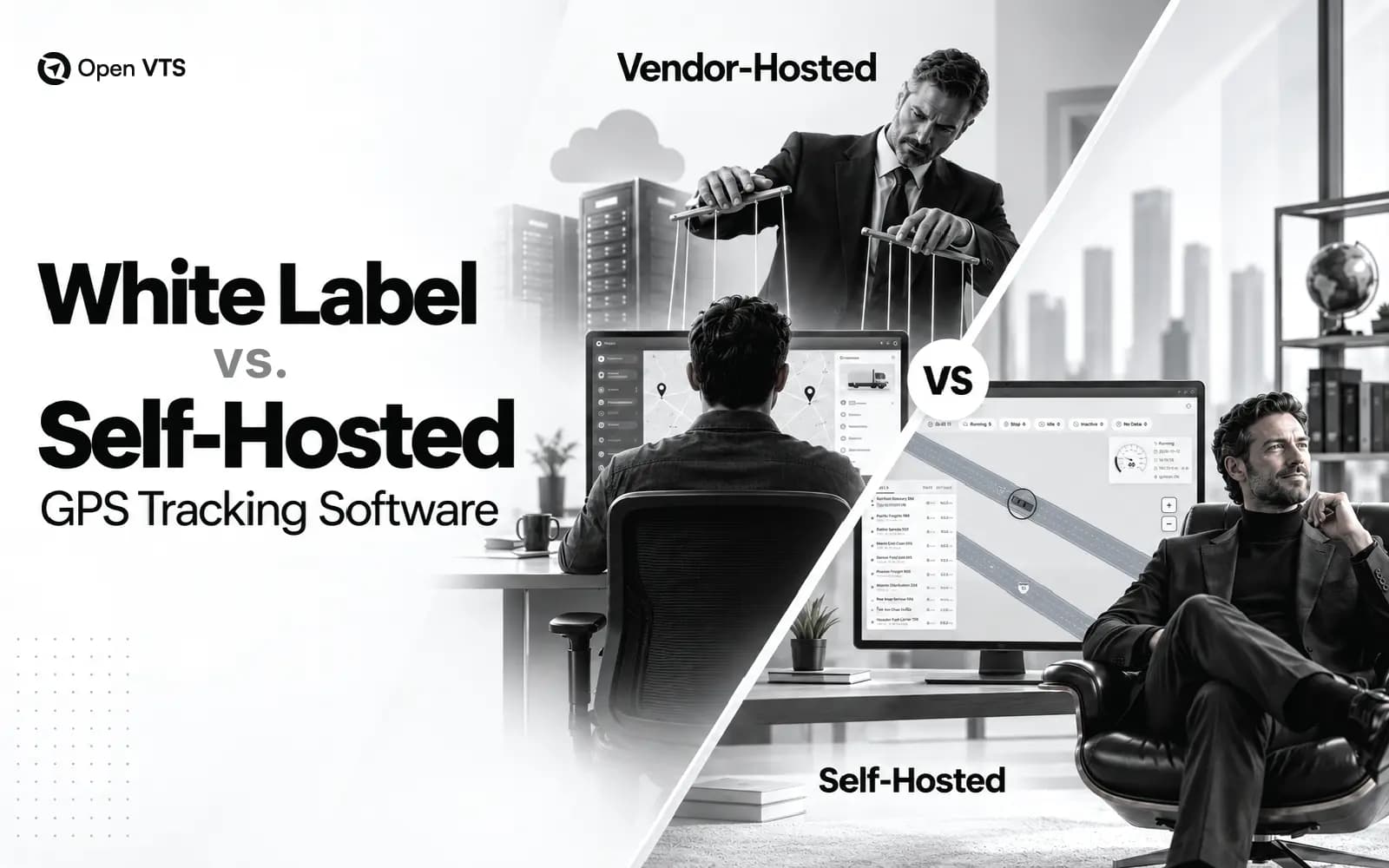
Choosing between white label GPS tracking software and self-hosted GPS software is not just a technical decision.

It is a business decision.

Both options can help you launch or manage a GPS tracking platform. Both can support real-time vehicle tracking, alerts, reports, geofencing, and fleet management.

But they are not the same.

A white-label GPS platform mainly gives you brand appearance. A self-hosted GPS platform gives you control and ownership.

That difference matters more than most fleet businesses realize.

If you are a GPS reseller, fleet operator, logistics company, or technology business planning to build a serious tracking brand, this guide will help you understand which model is better for your goals.

Quick Answer: What Is the Difference?

White label GPS tracking software is a ready-made GPS tracking platform developed by another company and rebranded with your logo, colors, domain, and sometimes mobile apps.

Self-hosted GPS software is installed on your own server or cloud infrastructure. Your GPS devices send data to your server, and you control the database, hosting, security, users, integrations, and long-term scaling.

The short version:

White label gives you a branded GPS tracking business. Self-hosted gives you a GPS tracking platform you truly control.

What Is White Label GPS Tracking Software?

White label GPS tracking software is a pre-built fleet tracking system that you can sell or operate under your own brand.

You do not build the software from scratch.

The provider already has the tracking dashboard, mobile app, reports, alerts, user management, maps, and device integrations. You simply add your company name, logo, colors, and sometimes your own domain.

Think of it like renting a fully furnished office.

Your company name is on the door. Your customers see your brand. But the building, rules, maintenance, and infrastructure still belong to someone else.

That is how most white-label GPS platforms work.

What Do You Usually Get in White Label GPS Software?

A typical white-label GPS tracking platform may include:

  • Branded web dashboard
  • Branded Android and iOS apps
  • Custom domain or subdomain
  • Real-time vehicle tracking
  • Route history
  • Geofencing
  • Speed alerts
  • Ignition alerts
  • Reports and analytics
  • Customer account management
  • Device management
  • API access
  • Reseller panel
  • Subscription or billing options

For a new GPS tracking reseller, this can be attractive.

You can launch faster. You do not need a large development team. You do not need to build device protocol support, map screens, reports, mobile apps, and admin panels from zero.

That speed is the biggest strength of white label GPS tracking software.

Who Should Choose White Label GPS Tracking Software?

White label GPS software can be a good choice if:

  • You want to start selling GPS tracking services quickly
  • You do not want to manage servers
  • You do not have a technical team
  • You need ready-made mobile apps
  • You want basic branding
  • You are testing a GPS reseller business
  • Your customers do not need deep customization
  • You are comfortable depending on a software vendor

For example, imagine a small GPS dealer with 40 local customers.

They do not want to build a tracking platform. They just want their own logo on the app and dashboard. In that case, a white-label platform can help them enter the market quickly.

But speed comes with trade-offs.

And those trade-offs become more serious as your business grows.

What Is Self-Hosted GPS Software?

Self-hosted GPS software is a GPS tracking platform installed on your own server, VPS, cloud account, or private infrastructure.

Instead of your devices sending data to a third-party vendor’s server, they send data to your server.

The basic flow looks like this:

GPS device → SIM/mobile network → your server → database → dashboard → reports and alerts

This means you control where your fleet data lives.

You control the server. You control the database. You control access. You control backups. You control security. You control how the platform grows.

That is the core power of self-hosted GPS software.

What Do You Control in Self-Hosted GPS Software?

With a self-hosted GPS tracking platform, you can usually control:

  • Server infrastructure
  • Database storage
  • Fleet data
  • User accounts
  • Admin permissions
  • Security rules
  • Backup strategy
  • Data retention
  • Custom integrations
  • API usage
  • Branding
  • Domain
  • Scaling
  • Update timing
  • Business workflows

This is a very different model from traditional white labeling.

White label is mostly about the outer layer of the business: logo, app name, dashboard colors, and customer-facing identity.

Self-hosted software goes deeper.

It gives you control over the system behind the brand.

The Real Difference: Branding vs. Ownership

This is the most important point.

White label GPS tracking software gives you brand appearance. Self-hosted GPS software gives you operational ownership.

With white label, your customer may see your logo.

But the core system may still be controlled by the vendor.

The vendor may control:

  • Where the data is stored
  • How many vehicles can you add
  • Which features can you use
  • What changes are allowed
  • How pricing grows
  • Which APIs are available
  • What happens if you stop paying
  • How updates are handled
  • Whether you can export or migrate your data easily

With self-hosted GPS software, you are not just putting your name on someone else’s platform.

You are building your tracking business on infrastructure you control.

That is a much stronger foundation if your goal is long-term independence.

Cost Difference: Recurring Fees vs. Ownership Model

Cost is one of the biggest reasons businesses compare white label and self-hosted GPS software.

At the beginning, white label can look cheaper.

You do not need to buy a server. You do not need to hire developers. You do not need to handle setup. You pay the provider and start selling.

But as your vehicle count grows, the cost can change quickly.

How White Label GPS Software Usually Charges

White-label GPS providers may charge based on:

  • Number of vehicles
  • Number of users
  • Number of resellers
  • Monthly subscription
  • Branded mobile app fee
  • Server usage
  • API usage
  • Add-on modules
  • Reports
  • Support plan
  • Data storage
  • Custom development

This model is simple at the start.

But if you are growing from 100 vehicles to 1,000 vehicles, every additional vehicle may increase your monthly cost.

That means your growth can make your software bill heavier.

How Self-Hosted GPS Software Usually Costs

Self-hosted GPS software usually has a different cost structure.

You may pay for:

  • Server or cloud hosting
  • Software license
  • Installation
  • Maintenance
  • Security setup
  • Backup storage
  • Optional support
  • Customization
  • Updates

The main difference is that self-hosted software often gives you more control over how costs scale.

You can upgrade your server. You can optimize your database. You can choose your hosting provider. You can decide your own infrastructure strategy.

You are not always forced into a fixed per-vehicle pricing model.

Simple Cost Example

Imagine you operate 500 vehicles.

With a white-label provider, you may pay a recurring fee for each vehicle every month. As you add more vehicles, your bill keeps growing.

With self-hosted GPS software, your server cost may increase as usage grows, but you have more control over how that growth is handled.

This does not mean self-hosted is always cheaper.

But it often becomes more attractive when:

  • Your fleet size grows
  • You need custom features
  • You want to reduce recurring dependency
  • You want control over hosting
  • You do not want pricing to increase with every business milestone

White label can be cheaper to start. Self-hosted can be stronger for long-term scale.

Data Ownership: The Hidden Difference Most Buyers Miss

GPS tracking data is sensitive.

It is not just dots on a map.

It can reveal:

  • Vehicle locations
  • Route history
  • Driver behavior
  • Delivery patterns
  • Customer locations
  • Business operations
  • Fuel usage
  • Asset movement
  • Stop points
  • Working hours
  • Fleet performance

For a logistics company, this data can expose how the business works.

For a GPS reseller, this data is connected to customer trust.

For an enterprise, this data may be part of compliance, security, or internal policy.

That is why data ownership matters.

Data in White Label GPS Software

In many white-label models, your customers see your brand, but the data may still be processed or stored inside the vendor’s system.

That means you need to ask important questions:

  • Where is the data stored?
  • Who can access it?
  • Can you export all data?
  • What happens if you cancel?
  • Is the database shared or isolated?
  • What security policies are used?
  • Can the vendor access customer data?
  • Are backups under your control?
  • Can you migrate to another platform easily?

Many businesses do not ask these questions early.

They only ask them when they are already locked in.

Data in Self-Hosted GPS Software

With self-hosted GPS software, your data stays on your own server or cloud infrastructure.

That gives you more control over:

  • Data location
  • Access rules
  • Backup policy
  • Retention period
  • Database security
  • User permissions
  • Compliance needs
  • Internal audits
  • Integrations
  • Export and migration

For businesses that care about privacy, security, and independence, this is a major advantage.

A tracking platform does not only track vehicles. It tracks the movement of your business.

That data should not be treated casually.

Customization Difference: Looks vs. Logic

White-label GPS software usually gives you surface-level customization.

Self-hosted GPS software can give you deeper system-level customization.

That is a major difference.

What You Can Customize in White Label GPS Software

White-label customization usually includes:

  • Logo
  • Brand colors
  • App name
  • Login screen
  • Domain
  • Email templates
  • Basic dashboard branding
  • Some report settings
  • Some alert settings

This is useful for brand presentation.

Your customer feels like they are using your platform.

But behind the scenes, your customization may be limited to what the vendor allows.

If you want a custom report, a special alert rule, a unique dashboard, or a deep integration, you may need to request it from the provider.

Sometimes they will do it.

Sometimes they will charge extra.

Sometimes they will say no.

What You Can Customize in Self-Hosted GPS Software

Self-hosted GPS software can give you deeper flexibility, especially when the platform is built for customization.

You may be able to customize:

  • Dashboard layout
  • User roles
  • Vehicle fields
  • Reports
  • Alerts
  • Geofencing rules
  • Driver behavior logic
  • API integrations
  • Billing workflows
  • Customer portals
  • Device protocol handling
  • Data retention
  • Mobile app behavior
  • Automation rules
  • ERP or CRM connections

Here is the simplest way to understand it:

White label lets you customize how the software looks. Self-hosted lets you customize how the software works.

That difference is huge.

Security Difference: Vendor Responsibility vs. Your Control

Security is another area where the two models feel very different.

White label reduces your technical responsibility.

Self-hosted increases your technical responsibility, but also gives you more control.

Security in White Label GPS Tracking Software

With white label, the provider usually manages:

  • Server security
  • Application updates
  • Database hosting
  • Backups
  • Uptime
  • Infrastructure monitoring
  • Bug fixes
  • Patch management

This is convenient.

You do not need to worry about server hardening, firewall rules, database backups, or hosting configuration.

But you are also trusting the provider’s security model.

Your business depends on their policies, their infrastructure, their response time, and their internal access controls.

That may be fine for many small businesses.

But for enterprises and serious GPS businesses, it can become a limitation.

Security in Self-Hosted GPS Software

With self-hosted software, you can define your own security model.

You can decide:

  • Where the server is hosted
  • Who has access
  • How backups are stored
  • Which firewall rules are active
  • How SSL is configured
  • How often updates are applied
  • How logs are monitored
  • How admin accounts are protected
  • How data is retained
  • How integrations are secured

This requires more responsibility.

But it also gives you more power.

For companies with strict privacy requirements, internal IT policies, or sensitive fleet operations, self-hosting can be a better fit.

Scalability Difference: Provider Limits vs. Infrastructure Control

Scalability is not only about adding more vehicles.

It is about whether your software model can grow with your business without creating new bottlenecks.

Scaling with White Label GPS Software

White label can scale quickly from a business point of view.

You can add more customers, vehicles, and users without building the platform yourself.

But your scaling depends on the provider.

You may face limits around:

  • Vehicle count
  • Storage
  • API calls
  • Report generation
  • Custom features
  • Device support
  • Reseller accounts
  • Pricing tiers
  • Data export
  • Server performance
  • Support response time

As long as your needs fit inside the provider’s system, white label works well.

But when your business becomes more advanced, the same convenience can become a constraint.

Scaling with Self-Hosted GPS Software

With self-hosted GPS software, scaling depends on your infrastructure and architecture.

You can improve:

  • Server capacity
  • Database performance
  • Storage
  • Caching
  • Backup strategy
  • API performance
  • Load handling
  • Security layers
  • Data retention
  • Deployment structure

This gives you more freedom.

You are not limited only by a vendor’s pricing page or package structure.

You can build your system around your own growth plan.

For a serious GPS software brand, that control matters.

Vendor Lock-In: The Risk Behind Convenience

Vendor lock-in happens when your business becomes dependent on one provider and cannot easily move away.

This can happen in white-label GPS software when:

  • Your customer data stays in the vendor’s system
  • Your branded apps belong to the vendor
  • Your domain setup depends on the vendor
  • Your reports cannot be exported fully
  • Your customers are tied to that platform
  • Your device configurations are difficult to migrate
  • Your business workflows are built around vendor limitations

At first, this may not feel like a problem.

But later, when your customer base grows, switching becomes painful.

Self-hosted GPS software reduces this risk because you have more control over your infrastructure and data.

You are not just renting access.

You are building an asset.

Can GPS Software Be Both White Label and Self-Hosted?

Yes.

This is the strongest model.

A GPS tracking platform can be self-hosted and white-label ready at the same time.

That means you can get:

  • Your own brand
  • Your own domain
  • Your own server
  • Your own database
  • Your own customer accounts
  • Your own data control
  • Your own pricing model
  • Your own integrations
  • Your own scaling strategy

This gives you the best of both worlds.

You get the brand power of white label and the infrastructure control of self-hosting.

For many growing GPS businesses, this is the ideal direction.

Because the real goal is not just to look like a GPS tracking company.

The real goal is to own the foundation of your GPS tracking business.

Real-World Example 1: A GPS Reseller Growing Too Fast

A GPS reseller starts with 75 vehicles.

At this stage, white label works well.

The reseller gets a branded dashboard, branded mobile app, and customer login. They do not need to hire developers. They can start selling quickly.

After one year, they reach 900 vehicles.

Now customers are asking for custom reports. Some want special alerts. Some want API access. Some want branded login pages for their own teams. The reseller also wants better control over pricing, data, and customer management.

Suddenly, the white-label model feels limited.

The reseller does not only need branding anymore.

They need control.

This is where self-hosted GPS software becomes more attractive.

Real-World Example 2: A Logistics Company with Sensitive Routes

A logistics company tracks high-value cargo across multiple regions.

Their tracking data includes route history, stop locations, driver movement, delivery timing, and customer locations.

For them, GPS data is business intelligence.

They do not want all of that information sitting inside a third-party vendor’s system without full control.

A self-hosted GPS platform allows them to keep data inside their own infrastructure, define strict user access, manage backups, and connect the platform with internal systems.

In this case, self-hosting is not only a software choice.

It is a security and business-control decision.

Real-World Example 3: A Fleet Business That Wants Custom Workflows

A fleet business wants more than basic tracking.

They want:

  • Custom driver scorecards
  • Maintenance alerts
  • Fuel reports
  • Client-specific dashboards
  • Billing automation
  • ERP integration
  • Special geofence logic
  • Custom user roles

With many white-label platforms, this level of customization may be difficult or expensive.

With self-hosted GPS software, the company has more freedom to build the platform around its own operations.

That is the difference between using a tool and building a system.

Common Misconceptions About White Label and Self-Hosted GPS Software

Misconception 1: White Label Means You Own the Software

Not always.

White label usually means you can use your brand on the software.

It does not automatically mean you own the source code, database, server, mobile apps, or infrastructure.

Before choosing a white-label provider, always check:

  • Who owns the data?
  • Who owns the app?
  • Who controls hosting?
  • Can you export everything?
  • What happens if you stop paying?
  • Can you migrate customers later?

Branding is not the same as ownership.

Misconception 2: Self-Hosted GPS Software Is Always Difficult

This used to be true for many older systems.

Self-hosted software often required technical knowledge, manual installation, server configuration, and ongoing maintenance.

But modern self-hosted platforms are becoming easier.

Some platforms now offer guided installation, simplified deployment, one-touch setup, documentation, and professional support.

The important question is not “Is it self-hosted?”

The real question is:

How easy is it to deploy, manage, update, and scale?

A good self-hosted GPS platform should not feel like a burden.

It should feel like control made simple.

Misconception 3: White Label Is Always Better for Resellers

White label is good for fast entry.

But it is not always better for serious resellers.

If your goal is to test the market, white label can work.

If your goal is to build a long-term GPS tracking brand, self-hosted software may give you a stronger foundation.

A serious reseller eventually needs more than a logo.

They need control over:

  • Pricing
  • Data
  • Customers
  • Features
  • Integrations
  • Infrastructure
  • Support experience
  • Long-term product direction

That is where self-hosted software becomes powerful.

Misconception 4: Self-Hosted Means No Branding

Self-hosted does not mean unbranded.

A strong self-hosted GPS platform can also support white-label branding.

That means you can run the software on your own server and still offer a branded experience to your customers.

This is the ideal model for businesses that want both:

Brand identity + platform ownership

Which One Is Better for Fleet Businesses?

It depends on your goal.

If you want speed, convenience, and low technical responsibility, white label may be better.

If you want control, ownership, privacy, customization, and long-term scalability, self-hosted GPS software is usually the stronger option.

Here is a simple decision guide.

Choose White Label GPS Tracking Software If:

White label is a better fit if:

  • You want to launch quickly
  • You do not want to manage servers
  • You are testing a new GPS business
  • You need ready-made branded apps
  • You have basic customization needs
  • You are comfortable with recurring fees
  • You trust the provider’s infrastructure
  • You do not need full database control
  • You want a simple reseller model

This is the faster path.

But it may not be the strongest long-term path.

Choose Self-Hosted GPS Software If:

Self-hosted GPS software is a better fit if:

  • You want full data control
  • You want your own server or cloud
  • You want long-term independence
  • You want deeper customization
  • You want to reduce vendor lock-in
  • You have 50+ vehicles or growing customer accounts
  • You need better privacy and security control
  • You want flexible integrations
  • You want to build a serious GPS software brand
  • You want ownership, not just branding

This is the stronger foundation for businesses that think long term.

The Best Choice: Self-Hosted GPS Software with White-Label Capability

The best model is not always white label versus self-hosted.

The best model is often:

Self-hosted GPS software with white-label capability.

This gives you the complete advantage:

  • You can use your own brand
  • You can host on your own server
  • You can control your data
  • You can manage your customers
  • You can reduce dependency
  • You can customize deeper
  • You can scale on your terms
  • You can build a real software asset

That is the direction many serious GPS businesses should think about.

Because the future belongs to companies that do not only sell tracking.

It belongs to companies that control the platform behind the tracking.

Where OpenVTS Fits In

OpenVTS is built around the idea that GPS tracking businesses should have more control.

Instead of depending completely on third-party SaaS platforms or limited white-label systems, OpenVTS focuses on a self-hosted approach where businesses can run GPS tracking software on their own infrastructure.

That matters because fleet data is valuable.

Your platform should not only help you track vehicles.

It should help you build independence.

With the right self-hosted GPS software, you can create a tracking ecosystem that fits your brand, your customers, your infrastructure, and your growth plan.

For a business that wants to look professional, stay flexible, and avoid long-term dependency, this is a powerful model.

Final Verdict: Which GPS Software Model Should You Choose?

White label GPS tracking software is good when you want to start fast.

It gives you a branded platform without building everything from scratch.

But white label usually focuses on appearance, not full ownership.

Self-hosted GPS software is better when you want deeper control.

It gives you more authority over your data, server, customization, security, and long-term growth.

So the real question is not:

“Which software has more features?”

The better question is:

Do you want to rent a branded GPS platform, or do you want to own the foundation of your GPS tracking business?

If you only need a quick reseller launch, white label may be enough.

But if you are building a serious GPS tracking brand, self-hosted GPS software gives you a stronger future.

Explore OpenVTS to build a GPS tracking platform with more control, more ownership, and more freedom to scale.

Frequently Asked Questions

What is the difference between white label GPS tracking software and self-hosted GPS software?

White label GPS tracking software is a ready-made tracking platform that you can rebrand with your logo, colors, domain, and app name. Self-hosted GPS software runs on your own server or cloud infrastructure, giving you more control over data, hosting, security, customization, and scaling.

Is white label GPS software the same as owning the software?

No. White label usually means you can brand the software, but it does not always mean you own the platform, source code, database, hosting, or infrastructure. Ownership depends on your agreement with the provider.

Is self-hosted GPS software better than white label GPS software?

Self-hosted GPS software is better if you need data ownership, privacy, customization, infrastructure control, and long-term independence. White label GPS software is better if you want to launch quickly with low technical responsibility.

Can self-hosted GPS software also be white-label?

Yes. Some self-hosted GPS platforms can also support white-label branding. This allows you to use your own brand while still controlling the server, database, data, and infrastructure.

Which GPS software model is better for resellers?

New resellers may prefer white label because it is faster to launch. Serious GPS resellers who want long-term control, custom pricing, data ownership, and platform independence may prefer self-hosted GPS software.