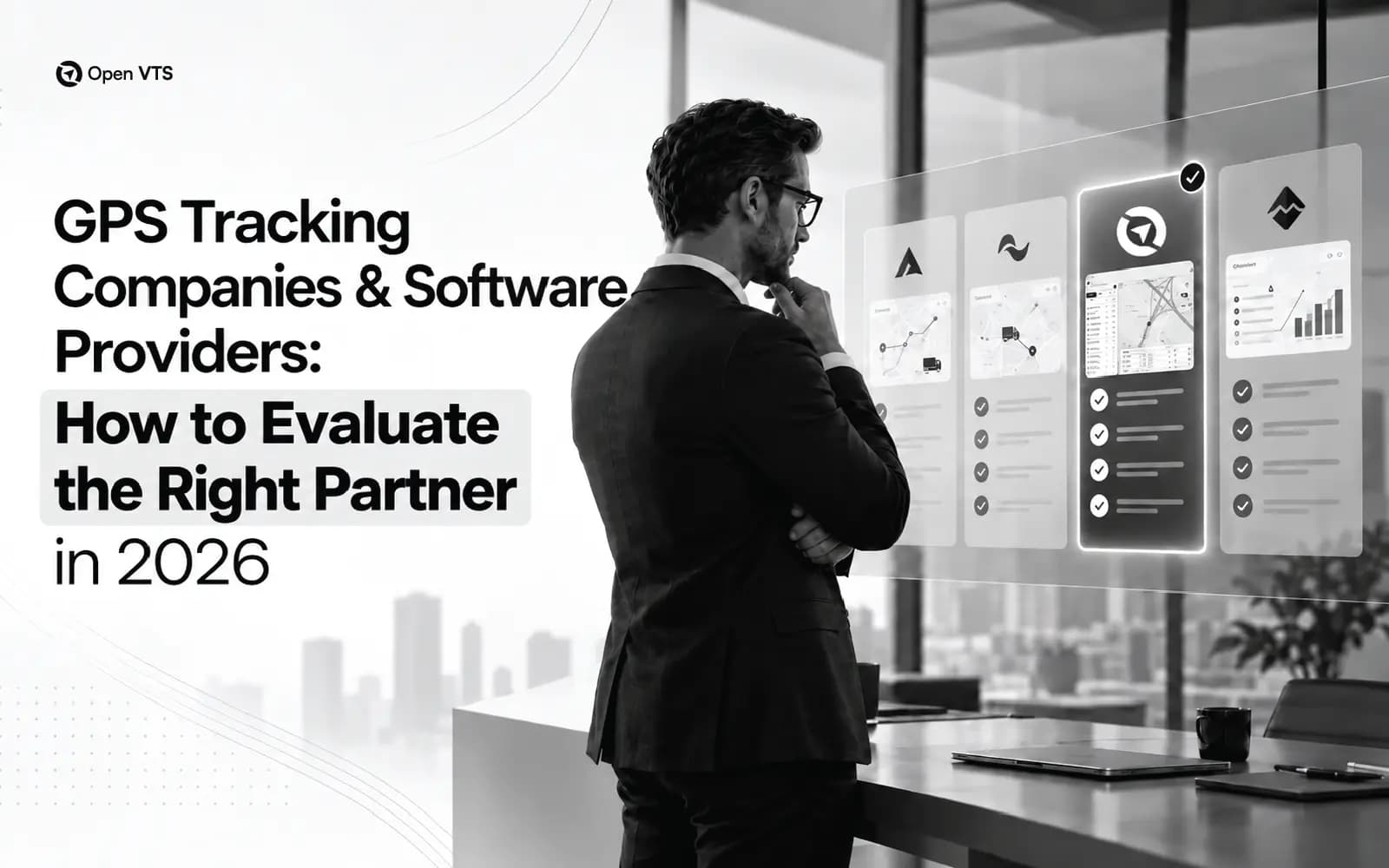
GPS Tracking Companies & Software Providers: How to Evaluate the Right Partner in 2026
Choosing a GPS tracking company in 2026 is more complicated than comparing live maps, geofences, reports, and monthly prices. Two providers may appear to sell similar tracking solutions while operating completely different business models. One may supply the hardware, cellular connectivity, cloud platform, installation, and support. Another may develop only the tracking software. A third may be a reseller or telematics service provider combining technology from several companies.
The right GPS tracking partner is the provider whose operating model matches the responsibilities you want to outsource or control, and whose claims about reliability, integrations, security, support, pricing, and data access can be verified under your real fleet conditions. Choose the provider model first, then compare individual companies.
Start by Choosing the Type of GPS Provider You Need
The phrase “GPS tracking provider” is broad enough to describe several fundamentally different businesses. Geotab, for example, develops telematics hardware and software while authorized resellers can provide consulting, integrations, training, ongoing support, and customer relationship management. Wialon follows another partner-led model, with more than 2,700 partner companies delivering Wialon-based telematics services around the world. These examples show why the company developing the software may not be the same company implementing or supporting your fleet.
| Provider model | What it usually provides | Best fit |
|---|---|---|
| Managed telematics provider | Hardware, connectivity, hosted software, implementation and support | Fleets wanting one vendor to operate most of the solution |
| GPS software/platform provider | Core tracking software, APIs and deployment technology | Technical teams, integrators and businesses wanting more platform control |
| TSP, reseller or integrator | Combines software, trackers, SIMs, installation, integration and local support | Organizations wanting a configured solution and service relationship |
| Hardware/connectivity provider | GPS devices, sensors, OEM data or cellular connectivity | Businesses building or operating their own software stack |
These models can overlap, so a buyer should establish which company is responsible for each layer before comparing feature lists.
Define the Business Problem Before Comparing Companies
A provider evaluation should begin with measurable operational requirements rather than a long list of available features. A delivery company might need reliable dispatch visibility and proof of route execution, while a long-haul carrier may care more about driver workflows, regulatory requirements, trailer visibility, and integration with a transportation management system. A service fleet may prioritize technician arrival information, idle reduction, job-system integration, and mobile workflows.
This distinction matters because almost every serious GPS platform can claim to offer maps, alerts, reports, and geofences. The more useful question is whether those capabilities solve the specific workflow being purchased. Before requesting demonstrations, define the vehicles and assets involved, required reporting frequency, critical alerts, integrations, history retention, operational users, expected growth, and measurable outcome the project must improve.
Evaluate the Provider Across Seven Areas
A structured evaluation prevents a polished demonstration from dominating the purchasing decision. A practical scorecard can assign 100 points across seven categories and require evidence for every important score.
| Evaluation area | Suggested weight |
|---|---|
| Operational and workflow fit | 20 |
| Data quality and reliability | 15 |
| Security, privacy and supplier risk | 15 |
| Integration and data portability | 15 |
| Hardware and connectivity fit | 10 |
| Implementation and support | 10 |
| Commercial terms and exit | 15 |
| Total | 100 |
The weights can change according to the fleet. A regulated carrier may increase the compliance component, while a GPS service company building its own commercial offering may place more weight on APIs, hardware independence, multi-tenancy, deployment control, and long-term platform economics. The purpose of the score is not to produce a universal ranking; it is to force each provider to be assessed against the same business requirements.
Data Quality Matters More Than the Dashboard
A modern interface can still sit on top of poor tracking data. When a company promises “real-time GPS tracking,” ask what that phrase means technically. Tracking freshness depends on how often the device generates positions, how quickly it sends them, cellular availability, server ingestion and processing, and how quickly the application delivers and renders the update. A five-second device reporting interval does not guarantee that a dispatcher always sees a five-second-old position.
The pilot should therefore test real operational conditions, including moving vehicles, stops, weak coverage, temporary network loss, reconnection, ignition events, geofence transitions, and periods of high fleet activity. Ask how devices buffer data while offline and whether delayed packets are replayed correctly after connectivity returns. Reliability should be measured from the vehicle to the user interface, not inferred from a vendor's infrastructure uptime percentage alone.
Check Integrations and Data Portability Before Signing
An integration logo on a website does not prove that the integration supports your actual workflow. A provider may connect with a TMS, ERP, payroll system, maintenance product, or BI tool while exposing only a limited set of fields or using an update frequency that does not meet the business requirement. Buyers should verify the required data objects, direction of data flow, frequency, error handling, authentication, rate limits, realtime events, and any additional API charges.
The same scrutiny should apply to data portability. “You own your data” is incomplete unless the provider explains how that data can actually be retrieved. Buyers should establish whether location history, trips, alerts, driver records, raw telemetry, reports, and other relevant records can be exported through an API or bulk process, how far back those records are retained, and what access remains after the contract ends.
Treat Security and Privacy as Supplier Due Diligence
A GPS provider handles information that can reveal where vehicles and people travel, when they stop, and how they behave on the road. The FTC's finalized 2026 order involving GM and OnStar followed allegations concerning the collection and sharing of precise geolocation and driving-behavior information, illustrating why location data deserves serious privacy governance. Supplier security should therefore be treated as procurement due diligence rather than a checkbox near the end of the process.
NIST's 2026 Cybersecurity Supply Chain Management Due Diligence guide recommends researching supplier provenance, resilience, foundational cybersecurity practices, and supply-chain dependencies before acquisition decisions. NIST's CSF 2.0 supply-chain guidance also emphasizes defining and communicating security requirements to suppliers, while CISA's Secure by Demand guidance encourages customers to explicitly demand secure-by-design practices from software manufacturers. Security claims should also be examined precisely.
If a company says it has a SOC 2 report, ask which service is covered, which report type applies, what period was examined, and which trust-services criteria are in scope. AICPA describes SOC 2 examinations around controls relevant to security, availability, processing integrity, confidentiality, and privacy; simply displaying “SOC 2” in a sales presentation does not answer those scope questions.
Compliance Claims Need Independent Verification
A provider's marketing department should never be the only source used to validate regulatory requirements. In the United States, electronic logging devices provide a useful example. FMCSA maintains the official registered ELD list and explicitly notes that listed devices are self-certified by manufacturers and are not endorsed by FMCSA.
The agency also removes devices that no longer meet requirements; multiple ELDs were removed from the registered list during 2026. For fleets subject to ELD requirements, procurement teams should verify the exact device name, model, software version, and identifier against the current FMCSA registry rather than accepting a generic statement that a provider is “ELD compliant.” The same principle applies elsewhere: identify the actual regulatory requirement, determine what component is responsible for meeting it, and verify that component using the appropriate authoritative source.
Support Is Part of the Product
The quality of the underlying software and the quality of the company supporting it are two separate risks. This becomes particularly important in partner-led ecosystems. Geotab's own partnership model shows that the technology developer can be responsible for software and hardware engineering while an authorized reseller becomes the fleet's ongoing resource for consulting, training, integrations, and support. Before signing, determine who handles installation failures, device replacement, platform configuration, integration issues, billing questions, and critical incidents.
Ask whether support is available directly from the technology developer or only through the reseller, how cases are escalated, what hours apply, and whether response targets are contractual. A strong product delivered through a weak implementation partner can still become a poor fleet system.
Test the Provider Before the Full Rollout
A controlled pilot should verify the claims that matter most before hundreds or thousands of devices are installed. Select vehicles representing different routes, operating environments, device types, and user groups, then define acceptance criteria before the pilot starts. Measure tracking freshness, trip accuracy, alert behavior, reporting, driver workflows, integration performance, installation quality, support responsiveness, and any operational metric the project is intended to improve.
Evidence should progress through a simple ladder: marketing claim → documentation → live demonstration → pilot verification → contract or SLA. A capability that appears only in a sales presentation should not receive the same confidence score as one proven in your own environment and reflected in the commercial agreement.
Read the Exit Terms Before the Entry Terms
Provider selection should include a migration scenario before the initial contract is signed. Determine who owns installed hardware, whether trackers can be redirected to another platform, what happens to SIM cards, how historical data can be exported, whether video or other large datasets can be retrieved, when API access ends, how deletion is handled, and whether the provider charges for migration assistance. Contract duration, automatic renewal, early termination, price changes, inactive vehicles, hardware replacement, minimum device counts, and end-of-service obligations can significantly change the economics of a GPS relationship.
An attractive first-year price matters less if leaving the service later requires replacing every tracker and abandoning years of operational data.
Where Open VTS Fits
Open VTS belongs to the self-hosted software/platform provider category rather than the traditional fully managed telematics-service model. Its current public positioning is customer-operated GPS tracking on infrastructure controlled by the customer, with Windows, Linux, and Docker deployment paths and a free tier for up to 50 vehicles. Its public API reference currently documents 426 endpoints, making API and integration evaluation a legitimate part of a technical due-diligence process. That model can fit businesses, integrators, or GPS service companies that want greater control over infrastructure, operational data, configuration, and integrations.
It is not automatically the right choice for a fleet that wants one supplier to provide the server environment, hardware, cellular service, installation, and ongoing operation as a managed package. The provider model should match the organization, not the other way around.
Choose Responsibilities First, Provider Second
The best GPS tracking company is not simply the vendor with the most features, the largest customer count, or the most polished demonstration. The right partner is the one whose responsibility model fits your organization and whose critical claims can be proven with documentation, testing, independent evidence, and contractual commitments. Before comparing names, map who will own hardware, connectivity, software, infrastructure, implementation, support, security, data access, and eventual migration. Once those responsibilities are clear, vendor comparison becomes much more meaningful—and the risk of choosing an impressive product delivered through the wrong operating model becomes much lower.