GPS Tracking Server: Architecture, Ports, Protocols, Database, Security & Deployment
A GPS tracking server is the network and processing layer between physical trackers and the applications people use to monitor vehicles. It must accept device connections, understand tracker-specific protocols, validate and acknowledge packets, convert them into a consistent telemetry model, store current and historical state, process events, and expose trusted information to APIs, maps, reports, and mobile applications.
A production GPS server should be designed as a protocol-aware telemetry system rather than a generic web server. There is no universal GPS port: each device protocol must reach a compatible listener, transport must be separated from decoding, acknowledgements must have defined durability semantics, and databases and internal services should remain isolated from the public network wherever possible.
What Is a GPS Tracking Server?
A GPS tracking server is the backend environment that receives telemetry sent by vehicle or asset trackers and transforms that raw network traffic into usable application data. The complete server path normally includes a listener that accepts TCP or UDP traffic, a protocol layer that understands the device's packet format, normalization logic that converts vendor-specific fields into a common internal model, durable storage for telemetry, current-state processing, business rules, and application services used by web and mobile clients. That distinction matters because the server is not receiving a location directly from GPS satellites.
The tracker first determines its position using satellite signals and then sends location and other telemetry through a communications network to a reachable server endpoint. The GPS server begins its job at that network boundary.
The End-to-End GPS Server Architecture
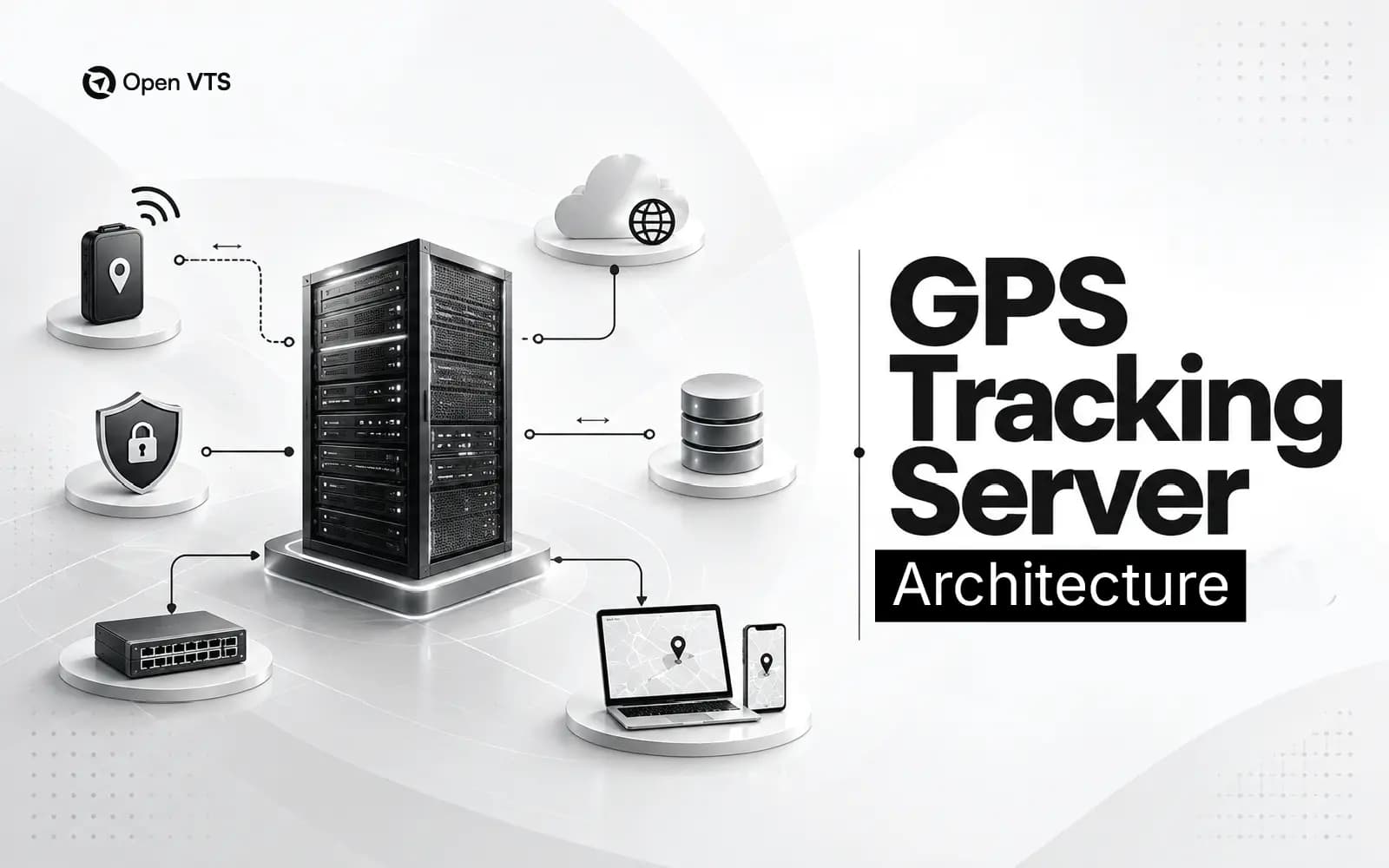
A useful architecture separates network ingestion from application processing:
Tracker → public listener port → TCP/UDP session handling → protocol framing → decoder → normalized event → durable ingest → current state + telemetry history → rules/events → APIs and realtime delivery → web/mobile applications The listener's primary job should be accepting traffic reliably rather than performing every downstream operation synchronously. Reporting, notifications, geofence processing, and heavy application queries should be decoupled where necessary so they cannot prevent devices from delivering telemetry. This separation becomes increasingly important as the platform grows because tracker connections form a continuous data plane while users generate very different API, report, and administrative workloads.
GPS Server Ports: There Is No Universal GPS Port
A common misconception is that GPS trackers use one standard network port. IANA maintains the official registry for TCP and UDP service names and divides ports into System Ports 0–1023, User Ports 1024–49151, and Dynamic/Private Ports 49152–65535, but there is no single universal GPS tracking-server port defined for all devices. In practice, the port number is meaningful only when combined with the service behind it.
A deployment may bind one device-protocol family to one TCP port and another family to a different TCP or UDP endpoint. Open VTS, for example, publishes a device catalogue that maps compatible hardware to a specific protocol and listener port so installers know what server endpoint to configure in the tracker. A practical server design should classify ports by trust boundary rather than treat them as one flat list:
| Port class | Purpose | Typical exposure |
|---|---|---|
| Device-ingress ports | Receive GPS tracker traffic | Public, only when required |
| Web/API ports | User dashboard and secure APIs | Public through HTTPS |
| Administration ports | SSH, RDP, management consoles | Restricted |
| Internal service ports | Database, cache, queues, diagnostics | Private |
| Outbound dependencies | Maps, messaging, updates, external APIs | Controlled egress |
This makes the firewall question much clearer: do not ask “Which ports can I open?” Ask which services genuinely need to cross each network boundary.
TCP vs UDP: Transport Is Not the Tracker Protocol
TCP and UDP determine how bytes move across the network; they do not define what a GPS packet means. TCP provides applications with a reliable, in-order byte stream, while UDP provides a minimal datagram service without TCP's built-in delivery, ordering, or duplicate-protection guarantees. A tracker protocol sits above that transport and defines the actual application message: device identity, timestamps, coordinates, sensor values, message length, checksums, record counts, acknowledgements, commands, and other fields.
This means a TCP listener still needs protocol framing because a single TCP read may contain part of a message or several messages together. UDP-based device protocols can also add their own packet IDs, retries, and acknowledgement schemes above UDP.
The correct mental model is:
Port = network endpointTCP/UDP = transport behaviorDevice protocol = packet meaning
Confusing those layers makes protocol debugging much harder.
From Raw Packet to Normalized Telemetry
Once a packet reaches the correct listener, the server must determine where a complete message begins and ends, validate its structure, identify the tracker, verify checksums or other integrity fields where defined, and pass the payload to the correct decoder. That decoder translates protocol-specific fields into an internal event model that the rest of the application can understand. Normalization is important because the reporting engine, map, alerts, and APIs should not need to know that one tracker calls ignition field A while another encodes it inside a bit field.
A normalized event might contain deviceId, eventTime, latitude, longitude, speed, heading, ignition, odometer, event type, and a flexible attributes object for additional sensor values. Raw-packet references should also be preserved where useful for diagnostics.
When Should the Server Acknowledge GPS Data?
Acknowledgements are one of the most important and least discussed parts of a tracking server. Many trackers treat a valid application-level ACK as confirmation that their data has been accepted and may delete that record from local memory. The server must therefore define exactly what “accepted” means before sending the response.
| ACK point | Benefit | Main trade-off |
|---|---|---|
| After decode | Very low response latency | Process may fail after ACK before durable storage |
| After database commit | Strong direct persistence semantics | Database latency blocks device session |
| After durable queue/spool | Fast ingest with downstream isolation | Requires reliable durable-ingest infrastructure |
There is no universal correct choice, but the choice must be deliberate. An ACK should represent received, validated, or durably accepted according to the server's documented policy. Otherwise, a crash immediately after acknowledgement can create silent data loss that neither the tracker nor the backend knows how to recover.
Database Design: Current State and History Are Different Workloads
A dispatcher asking “Where is vehicle 42 now?” and an analyst asking “Where did vehicle 42 travel during the previous 90 days?” should not require the same query pattern. A mature server therefore distinguishes application/master data, latest operational state, and append-oriented telemetry history. For large historical tables, PostgreSQL supports table partitioning so one logical table can be separated into smaller physical partitions, improving some query, retention, and bulk-removal patterns when the data becomes sufficiently large.
For geofence containment, nearby-location searches, and other spatial operations, PostGIS emphasizes spatial indexes such as GiST because normal B-tree indexes do not accelerate geometry queries. A cache may make current-state reads faster, but it should not silently become the only authoritative copy of important telemetry unless the recovery design explicitly supports that model. Current state should be reconstructable from durable data or another defined durability layer.
Size the Server by Message Rate, Not Vehicle Count Alone
Vehicle count is an incomplete capacity metric. Reporting interval changes server load dramatically:
| Active devices | 60-sec reporting | 10-sec reporting | 5-sec reporting |
|---|---|---|---|
| 1,000 | ~17 records/sec | 100/sec 200/sec | |
| 5,000 | ~83/sec | 500/sec | 1,000/sec |
| 10,000 | ~167/sec | 1,000/sec | 2,000/sec |
| 20,000 | ~333/sec | 2,000/sec | 4,000/sec |
At 10,000 continuously reporting devices, a 10-second interval represents approximately 86.4 million records per day. Real workloads vary because vehicles stop, devices sleep, connections drop, event packets arrive, and trackers may upload multiple historical records inside one packet. That is why capacity planning should include active-device percentage, packets per second, records per packet, retention, payload size, reports, integrations, and concurrent users rather than only the licensed fleet count.
Security: Separate Public Ports From Private Services
Every public listener accepts untrusted network input, so GPS ingestion ports should be considered part of the attack surface. Expose only required protocols, validate packet lengths and fields defensively, rate-limit or isolate abusive sources where practical, keep dependencies patched, and avoid giving a device session unnecessary privileges. NIST's firewall guidance recommends defining explicit inbound and outbound policy around the traffic an organization actually requires and generally blocking traffic that is not expressly permitted.
The same principle should be applied internally: PostgreSQL, caches, worker diagnostics, and internal APIs usually belong on private networks rather than the public internet. Administrative access should receive even stricter treatment through trusted IPs, VPNs, bastion access, or equivalent controls. Device identification alone should also not be confused with strong authentication; many legacy trackers were designed under much weaker security assumptions than modern web applications.
Deployment: Single Server, Containers and Horizontal Scale
A well-structured single server can be an entirely reasonable starting point. Listener, backend, database, cache, and web components can initially coexist while remaining logically separated. Horizontal distribution becomes valuable when connection volume, CPU, database traffic, reporting, availability requirements, or organizational scale justify the added complexity. One GPS-specific challenge appears when listeners scale horizontally: connection ownership. If a tracker maintains a TCP session with listener worker A, a command initiated through an API on another process must know where that active session lives.
A distributed deployment therefore needs a routing mechanism for device commands, connection-state ownership, graceful worker draining, and reconnect behavior. Containerization helps package the services consistently, but it does not make the network secure automatically. Docker explicitly warns that published ports become externally reachable by default unless bindings or firewall configuration restrict them. Publish the ports that genuinely need public access and keep database/cache services on internal networks.
Observability, Backup and Recovery
A production GPS server should monitor device and application behavior, not merely CPU and RAM. Useful metrics include connected sessions, packet rate, decoded records, protocol failures, checksum errors, unknown devices, acknowledgement latency, queue depth, database write time, delayed telemetry, current-state freshness, command failures, worker restarts, and storage growth.
OpenTelemetry describes observability around signals such as traces, metrics, and logs, which provides a useful framework for connecting packet-level failures to wider system behavior. Backups are equally important, but a successful backup job is not the goal—a successful restore is. Test recovery of telemetry history, configuration, credentials, application state, and protocol settings, and define what the server should do when the database or downstream processors temporarily become unavailable.
Where Open VTS Fits
Open VTS provides a practical example of this server separation. Its public documentation describes a self-hosted environment where web-facing ports and GPS device protocol ports are exposed as required while PostgreSQL, Redis, backend services, and internal diagnostics are kept private. Its supported-device catalogue also maps hardware models to the correct protocol and listener port, helping operators configure trackers against the appropriate server endpoint. For teams designing their own server, that implementation is useful as evidence of a broader principle: a mature GPS platform needs distinct network boundaries for trackers, users, application services, and data infrastructure rather than exposing every component directly.
Final Rule: Expose Less, Acknowledge Deliberately, Persist Durably
The strongest GPS server architecture is not the one with the largest port range or the most complicated microservice diagram. It is the one that clearly defines what each endpoint accepts, what each acknowledgement guarantees, where telemetry becomes durable, how current state differs from history, which services remain private, and how the platform behaves when part of the system fails. Treat the tracker connection as the beginning of a reliability chain rather than the end of a networking task.
Bind the correct protocol to the correct endpoint, validate untrusted data, acknowledge according to a deliberate durability policy, keep internal infrastructure private, and size the system from real telemetry workload. Those principles scale from a small self-hosted server to a distributed enterprise tracking platform.