
Self-hosted GPS software is a GPS tracking platform that runs on your own server instead of a vendor’s shared cloud infrastructure. That one difference changes everything. It changes where your fleet data is stored, who controls the database, how much flexibility your business has, and how your GPS operations can scale over time.
In simple terms, self-hosted GPS software allows businesses to track vehicles, assets, drivers, routes, alerts, and reports using their own infrastructure. GPS devices send data directly to your server, while your team controls the system, users, security, integrations, and data access. Most GPS tracking platforms only give businesses access to the software, but self-hosted GPS software gives businesses control over the software itself.
GPS Tracker vs Self-Hosted GPS Software
A GPS tracker is the physical device installed inside a vehicle, while self-hosted GPS software is the platform that receives, stores, and displays the tracking data from that device.
In simple terms, the GPS tracker collects location and movement data, and the software turns that raw data into useful information such as live tracking, route history, alerts, reports, and fleet insights.
How Self-Hosted GPS Software Works
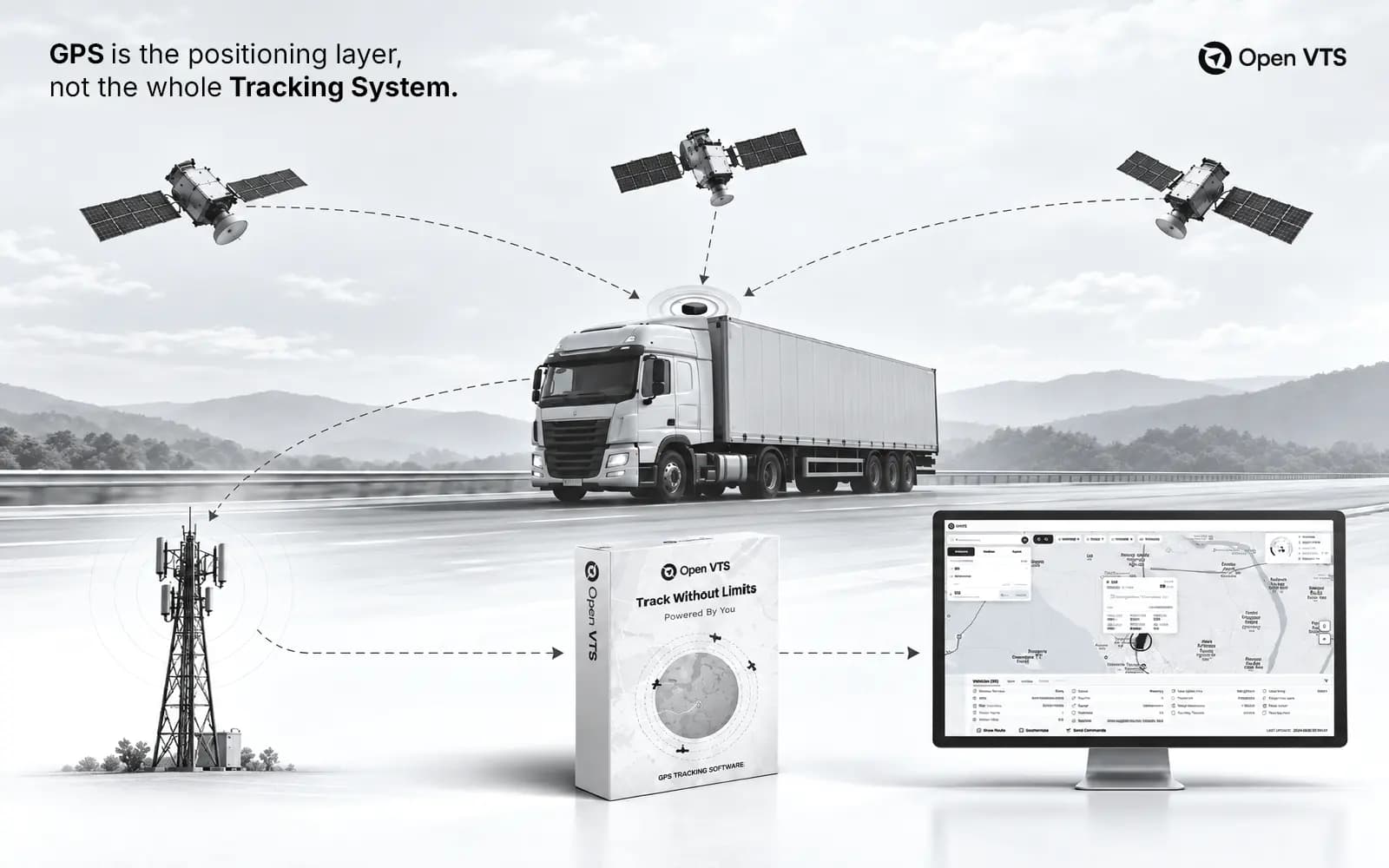
Self-hosted GPS software works through a simple process. A GPS device installed in the vehicle collects location and movement data while the vehicle is running. That data is then sent through a mobile network to your own server, where the system processes, stores, and displays it inside the tracking dashboard.
The overall flow looks like this:
GPS device → mobile network → your server → database → dashboard → alerts and reports
That is the basic concept behind self-hosted GPS tracking. But every step in this process matters because the quality of the device, network, server, database, and software directly affects tracking accuracy, reliability, alerts, and reporting performance.
Step 1: The GPS Device Collects Vehicle Data
A GPS device is installed inside the vehicle to collect tracking information. It receives satellite signals and calculates the vehicle’s location, movement, and status. The tracker can collect data such as latitude, longitude, speed, direction, ignition status, battery level, odometer readings, engine hours, sensor information, and driver behavior data.
The device itself does not display maps or reports. Its job is only to collect and send data. The software turns that raw information into a useful tracking dashboard.
Step 2: The Device Sends Data to Your Server
Once the GPS device collects data, it sends the information through a network such as GPRS, 4G, LTE, NB-IoT, or satellite connectivity.
In a SaaS platform, the device sends data to the vendor’s server. In a self-hosted setup, the device sends data directly to your own server IP or domain. That is the key difference — your infrastructure becomes the destination, and your platform becomes the main source of truth for all tracking data.
Step 3: Your Server Processes the Data
The server receives raw GPS packets and processes them into meaningful tracking information. It identifies the device, matches it to the correct vehicle, validates the data, updates movement status, checks ignition activity, processes geofences, creates alerts, and updates route history.
This is the real engine behind GPS tracking software. The map is only the visible layer, while the server handles the actual logic and processing. Over time, most businesses realize that data accuracy and server performance matter far more than attractive dashboards alone.
Step 4: The Database Stores Tracking History
The database stores all tracking history for future use. This historical data powers features such as route replay, trip reports, idle reports, speed reports, stoppage analysis, maintenance tracking, and audit records.
Live tracking shows what is happening right now, but historical data explains what actually happened. That becomes extremely important when businesses need proof for customer disputes, driver behavior, billing, compliance, or operational analysis.
Step 5: Users Access the Dashboard
Fleet managers, admins, and customers access the system through a web dashboard or mobile app. From there, they can monitor live vehicle locations, moving and stopped vehicles, alerts, reports, geofences, drivers, and account settings.
A good dashboard should feel simple and fast. Fleet managers do not want complicated screens — they want quick answers to operational questions like:
Which vehicle is delayed? Which driver stopped too long? Which route was used? Which alert needs attention?
Good GPS software helps users answer these questions quickly and clearly.
Self-Hosted GPS Software vs SaaS GPS Tracking
This is one of the most important comparisons in the GPS tracking industry. Both SaaS and self-hosted GPS software can track vehicles, display live maps, send alerts, and generate reports. But behind the features, they follow very different business models.
What Is SaaS GPS Tracking?
SaaS (Software as a Service) GPS tracking is hosted and managed by the vendor. Businesses access the platform through a web browser or mobile app and usually pay a monthly or yearly subscription fee.
In this model, the vendor controls the server, database, hosting, updates, backups, core features, and overall platform environment. SaaS platforms are popular because they are easier to start, require less technical setup, and reduce infrastructure management.
However, that convenience also means less control over the system, data, customization, and long-term scalability.
What Is Self-Hosted GPS Tracking?
Self-hosted GPS tracking runs on your own infrastructure instead of the vendor’s servers. Your business controls the server, database, data storage, backups, access rules, integrations, security settings, branding, and scaling strategy.
This approach requires more responsibility and technical management, but it also provides much greater ownership, flexibility, and independence.
That trade-off is the real decision businesses need to make when choosing between SaaS and self-hosted GPS tracking software.
Which One Should You Choose?
SaaS GPS tracking is usually a good choice for businesses that want a quick setup, have a smaller fleet, and do not want to manage servers or technical infrastructure. It works well for companies that are comfortable with vendor-managed hosting and do not require heavy customization or deep system control.
Self-hosted GPS tracking is better suited for businesses that want full ownership of their data, stronger privacy control, custom integrations, long-term cost flexibility, and freedom from vendor lock-in. It is especially valuable for large fleets, GPS service providers, and businesses building their own tracking brand.
There is no single perfect solution for every company. But one pattern is clear — as fleet operations grow and tracking data becomes more important, control starts to matter much more.
Why Businesses Choose Self-Hosted GPS Software
Businesses choose self-hosted GPS software mainly for one reason — control. Control over data, infrastructure, security, branding, customization, and long-term business growth. As fleet operations become more data-driven, companies want stronger ownership over the systems that manage their vehicles and operations.
Full Data Ownership
GPS tracking data includes routes, customer locations, driver behavior, stoppages, and operational activity. With self-hosted GPS software, businesses control where that data is stored, who can access it, how backups work, and how long data is retained. This is especially important for industries where privacy and operational control matter.
More Privacy and Security Control
Self-hosted systems allow businesses to apply their own security standards, including firewall rules, VPN access, SSL certificates, backup policies, and role-based permissions. Instead of depending completely on a vendor, companies manage security based on their own requirements.
No Vendor Lock-In
Many SaaS platforms create dependency around pricing, data access, APIs, and device support. Self-hosted GPS software reduces this risk by giving businesses more control over their infrastructure and long-term platform decisions.
Better Long-Term Cost Control
SaaS platforms often charge per vehicle, which can become expensive as fleets grow. Self-hosted software may require server and maintenance costs, but it often provides better long-term cost flexibility for larger fleets and GPS service providers.
More Customization
Different businesses need different workflows, integrations, and reporting systems. Self-hosted GPS software offers greater flexibility for custom features, API integrations, branding, and operational workflows, making it a stronger long-term solution for growing businesses.
What to Check Before Choosing Self-Hosted GPS Software
Self-hosted GPS software can offer strong control and flexibility, but choosing the wrong platform can create performance, security, and operational problems. Before making a decision, it is important to evaluate the platform carefully.
Check Installation and Setup
Start by checking how easy the platform is to install and manage. Review the installation process, server requirements, backup setup, SSL configuration, and update workflow. Some platforms require advanced technical knowledge, while others are designed for simpler deployment.
For example, OpenVTS focuses on self-hosted deployment with infrastructure ownership and reduced third-party dependency.
Check Device Compatibility and Tracking Accuracy
Your GPS software should support multiple GPS devices and common protocols so you are not locked into one hardware provider. Also test real-world tracking quality, including route history, trip replay, idle time, stoppage detection, and offline recovery.
A platform should not only look good on a live map — it should provide reliable historical data and accurate reporting.
Check Reports, Alerts, and User Roles
Good GPS software should include useful reports, flexible alerts, and proper access control. Businesses should be able to manage reports, notifications, drivers, customers, and admin roles without confusion.
This becomes especially important for larger fleets and GPS service providers.
Check APIs, Security, and Backups
Modern GPS platforms should support API integrations with ERP systems, dispatch tools, billing software, and customer portals. Open access to data helps businesses build future automation and analytics.
Since self-hosted systems give businesses full control, strong backups, SSL security, firewall protection, and role-based permissions are also essential.
OpenVTS and the Future of Self-Hosted GPS Software
OpenVTS fits the self-hosted GPS software category because it is built around one core idea — ownership. Not just vehicle tracking, but ownership of the platform, infrastructure, and data behind the tracking system.
The platform is designed for businesses that want to run GPS tracking on their own infrastructure instead of depending completely on third-party SaaS providers. That gives companies more control over servers, databases, branding, APIs, integrations, customer experience, and long-term scalability.
This positioning is especially strong in a market where most GPS platforms mainly sell convenience. OpenVTS focuses on something deeper: tracking with ownership. That message appeals to GPS service providers, fleet operators, enterprises, and businesses that want stronger control over their data and operations while avoiding long-term vendor lock-in.
OpenVTS is particularly relevant for GPS startups, white-label GPS businesses, logistics companies, school transport operators, construction fleets, government fleets, and enterprises with private infrastructure requirements. It is also a strong fit for companies that want to build their own branded GPS tracking platform with greater independence and flexibility.
Final Takeaway
Self-hosted GPS software is more than just a vehicle tracking platform running on your own server or private cloud. It gives businesses control over their infrastructure, tracking data, users, integrations, reports, and long-term operations. While SaaS GPS platforms focus on convenience, self-hosted GPS software focuses on ownership — and that difference is becoming more important in 2026.
As fleet operations become more connected and AI-driven, businesses want stronger control over their systems and data. Customers expect better visibility, while companies need more flexibility, privacy, and scalability. That is where OpenVTS positions itself differently — helping businesses not only track vehicles, but also own the system behind the tracking.